Railway, Render, Fly.io, Vercel and Heroku: 12 Weeks of Status-Page Incidents, Counted
Five hosting status pages, the same 12 weeks, every incident counted and timed where the data allows. Fly.io posts the most. Render had none over four hours.

Railway had a rough October. On the 21st it paused all builds, then disclosed that an attacker may have read some customers' environment variables (Railway's disclosure). It spent the next day bringing builds back plan by plan. A lot of people started asking where to move.
Before you pick a new host on reputation, look at what each one admits to on its own status page. We pulled the incident history of five hosting platforms for the same 12 weeks and counted every incident and how long it lasted.
How we tested: On October 22, 2026 we downloaded the public incident data behind the status pages of Railway, Render, Fly.io, Vercel and Heroku, and counted every incident opened between July 30 and October 21, 2026 (UTC) with its duration. No accounts and nothing paid. We wrote the counting script and took the screenshot ourselves.
The count
| Platform | Incidents posted | Per week | Lasting 4 hours or more | Longest | Total hours |
|---|---|---|---|---|---|
| Fly.io | 48 | 4.0 | 8 | 12.9 h | 100.5 |
| Railway | 29 | 2.4 | 2 | 26.6 h, still open on Oct 22 | 74.0 |
| Vercel | 22 | 1.8 | 2 | 6.9 h | 28.4 |
| Render | 12 | 1.0 | 0 | 3.9 h | 17.4 |
| Heroku | 5 | 0.4 | not measurable | not measurable | not measurable |
Incidents opened from July 30 to October 21, 2026 (UTC), from each platform's own status page, downloaded on October 22 at 09:58 UTC. Total hours add up each incident's length, so two overlapping incidents count twice. Scheduled maintenance isn't included.
Why a count isn't an uptime score
Each company decides what goes on its status page. Fly.io posts a lot of small, regional incidents. Of its 48 incident titles, 20 name a single region, such as capacity issues in São Paulo. Heroku posted five in 12 weeks, and two of those were added after the fact with zero duration in the feed. Neither number tells you whose servers were up more.
The five pages don't even use the same words for how bad an incident was. Render and Vercel rate theirs none, minor, major or critical, Fly.io and Railway use degraded performance, partial outage and full or major outage, and Heroku's feed gives no per-incident severity at all. So we kept each company's own labels in our data and didn't rank on them.
Railway
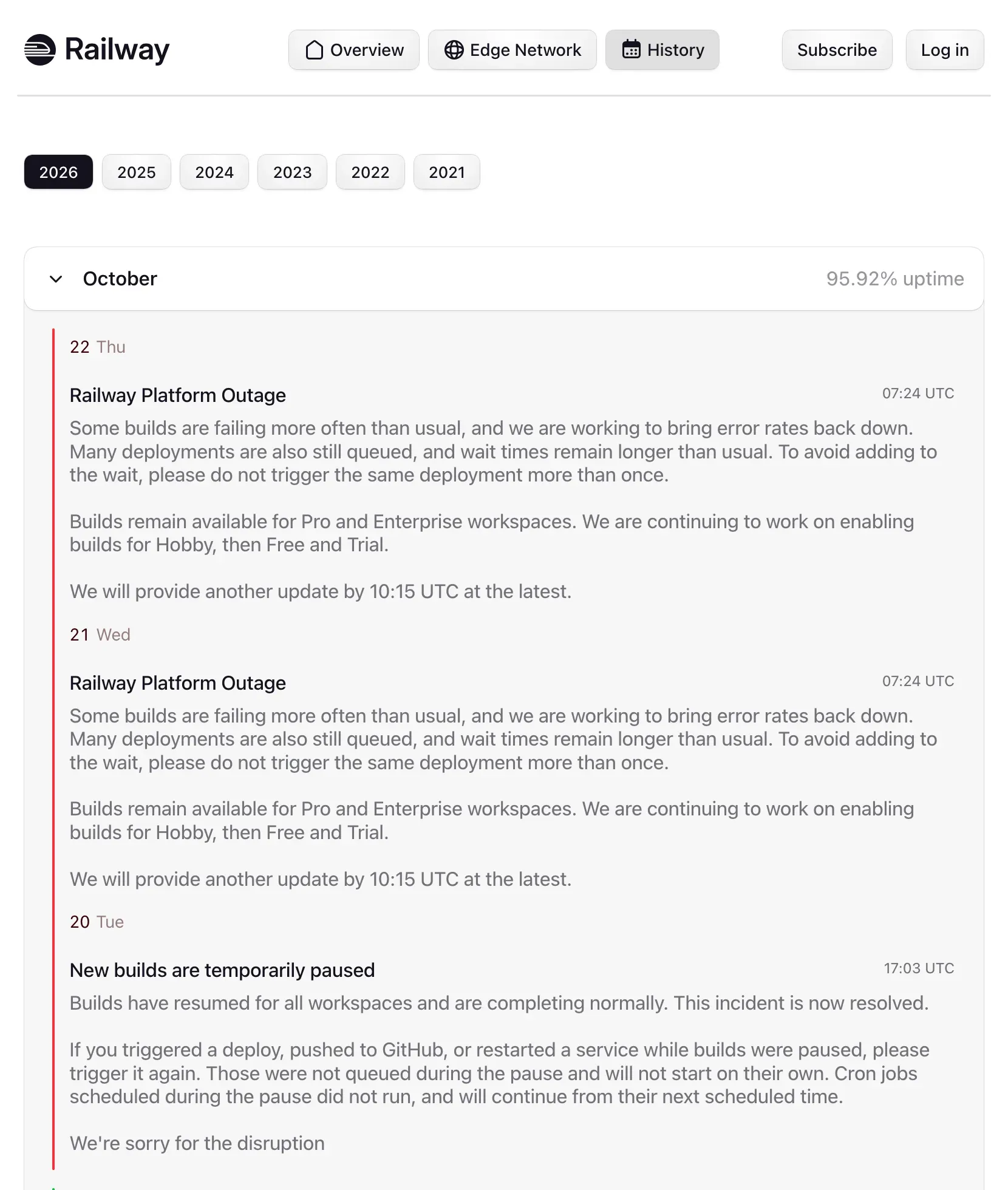
29 incidents, and the longest stretch in the table. The "Railway Platform Outage" opened at 07:24 UTC on October 21, more than 14 hours before Railway linked its security notice from the incident. It had run 26.6 hours when we downloaded the data, and Railway's own history page showed October at 95.92% uptime:
Its other long incident, 7.5 hours on August 17, was a GitHub problem, as its own title says ("GitHub is experiencing elevated error rates"). Before October, most of Railway's incidents were short. Half of those 18 were resolved within about 1.4 hours.
Fly.io
48 incidents, the most, and 8 that lasted four hours or more. The longest was 12.9 hours of "Platform Wide Rolling Host Reboots" on October 16. Several of the long ones were limited to one region or one product, such as Managed Postgres creation failing in São Paulo for 8.3 hours on August 4. If your app lives in a region Fly.io rarely mentions, its count overstates your risk. If it lives in one it mentions often, it doesn't.
Vercel
22 incidents, two over four hours: a 6.9-hour partial disruption of dashboard features, including observability and analytics, on August 17, and 6.6 hours of increased build and deployment failures on October 12. Five of its incidents were opened and closed at the same moment, usually a sign they were posted after the fact.
Render
12 incidents, and none lasted four hours. The longest was 3.9 hours of deployment issues on August 20. Seven of the twelve were labelled minor.
Heroku
Five incidents, too few and too oddly recorded to time. Heroku's feed often leaves the resolved time empty while marking the incident resolved, two incidents were posted retroactively, and one has its "resolved" update timestamped before the incident itself. A quiet status page isn't proof of a quiet platform.
If you're leaving Railway this week
- Render had the fewest incidents of the four we could time, and none that lasted four hours. It runs web services with a managed database, as Railway does. We compared Railway, Render and Fly.io on features and price separately.
- Fly.io posts more than anyone, and many of its incidents name one region. Check its history for the region you'd deploy in before you count it against it.
- Vercel is built around frontends and serverless functions, and its long-running workers (Vercel Daemons) are still in beta. Our Vercel alternatives post covers that split.
- Heroku looks calm on paper, and the data is too thin to say more. See Heroku alternatives if you're weighing it against the rest.
Whichever you pick, don't rely on the vendor's page to tell you when your app is down. An outside uptime monitor checks your app, not their platform, and costs little or nothing to start (uptime monitoring tools we've compared).
If you've moved hosts this month, tell us where and why on X at @devtoolpicks.
Get honest tool comparisons in your inbox
Join 50+ indie hackers and solo developers who get new comparisons, pricing changes, and tool picks. No spam. Unsubscribe anytime.
Related Articles

Best Tailscale Alternatives for Indie Hackers in 2026
Tailscale is excellent but per-user pricing adds up fast. Here are 4 alternative...

Best Netlify Alternatives for Indie Hackers in 2026
Netlify switched to credit-based billing in 2025. Here are 4 alternatives that m...

Best Vercel Alternatives for Indie Hackers in 2026 (Honest Picks)
Vercel's pricing breaks the moment you ship real traffic. Here are 5 honest alte...