What Burns Your Claude Code Limit: Subagents Cost 2.6x, MCP Servers Almost Nothing
One bug fix, run again and again with one setting changed each time. Subagents more than doubled the cost. MCP servers barely registered.

Claude Code users spent the week of October 19 posting that their limit drains faster. "My usage for basically the same task was about 3X since the weekend" had 523 likes and 104 replies by October 21 (the post on X, October 20). We found no statement from Anthropic by October 22, and nobody outside Anthropic can see how a plan is metered.
What you can measure is what your own setup sends. So we ran one bug fix in Claude Code again and again, changing one thing at a time, and counted the tokens.
Subagents more than doubled the cost of the same fix. Coming back to a session after an hour away cost ten times as much as coming back within the hour. Medium effort, Claude Code's default for Sonnet 5.5, was the cheapest setting and passed every test. MCP servers barely registered. A CLAUDE.md file cost more, and it's paid on every request.
How we tested: On October 22, 2026 we ran the same two-ticket billing bug through Claude Code 2.1.308 on a Claude subscription, with Claude Sonnet 5.5 at high effort as the baseline and one setting changed per run. Each setting ran twice (the two Opus settings once), every run was judged by the same 8 hidden tests, and
CLAUDE.mdand MCP servers were measured on a one-word request. Token counts and list-price costs come from Claude Code's own output, and the screenshots are ours.
The results
| What we changed | Cost per fix | Against baseline | Hidden tests passed |
|---|---|---|---|
| Baseline (Sonnet 5.5, high effort) | $0.108 | 1.0x | 8 of 8, both runs |
| Medium effort (Claude Code's default for Sonnet 5.5) | $0.076 | 0.70x | 8 of 8, both runs |
| Low effort | $0.094 | 0.87x | 8 of 8, both runs |
| Three subagents | $0.276 | 2.55x | 8 of 8, both runs |
Three subagents, CLAUDE_CODE_SUBAGENT_MODEL=claude-haiku-5-5 |
$0.280 and $0.169 | 2.6x and 1.6x | 8 of 8, both runs |
| Three subagents, forced onto Haiku | $0.201 | 1.86x | 8 of 8, both runs |
| Opus 5.5 instead of Sonnet, three subagents | $0.784 | 7.3x | 8 of 8, one run |
| Opus 5.5, subagents forced onto Haiku | $0.414 | 3.8x | 8 of 8, one run |
Costs are Claude Code's own list-price figure for each run, at API prices (Anthropic pricing, checked October 22, 2026). For Sonnet 5.5 that's $2 per million input tokens, $2.50 for five-minute cache writes, $4 for one-hour cache writes, $0.10 for cache reads and $10 for output. Opus 5.5 costs exactly twice that. On a subscription you pay none of it per token. We use it as a yardstick for what moves your limit, because Anthropic publishes limits as a rolling five-hour window plus weekly caps, shared by every Claude app, not as a token count (Claude pricing, checked October 22, 2026).
What does every request carry before you type?
In our setup, 17,271 tokens, by the API's own count for a request that only says "Reply with the single word ok". Claude Code's /context command estimates the same request lower, at 13.4k, but its breakdown shows that most of it is tool definitions, not the system prompt.
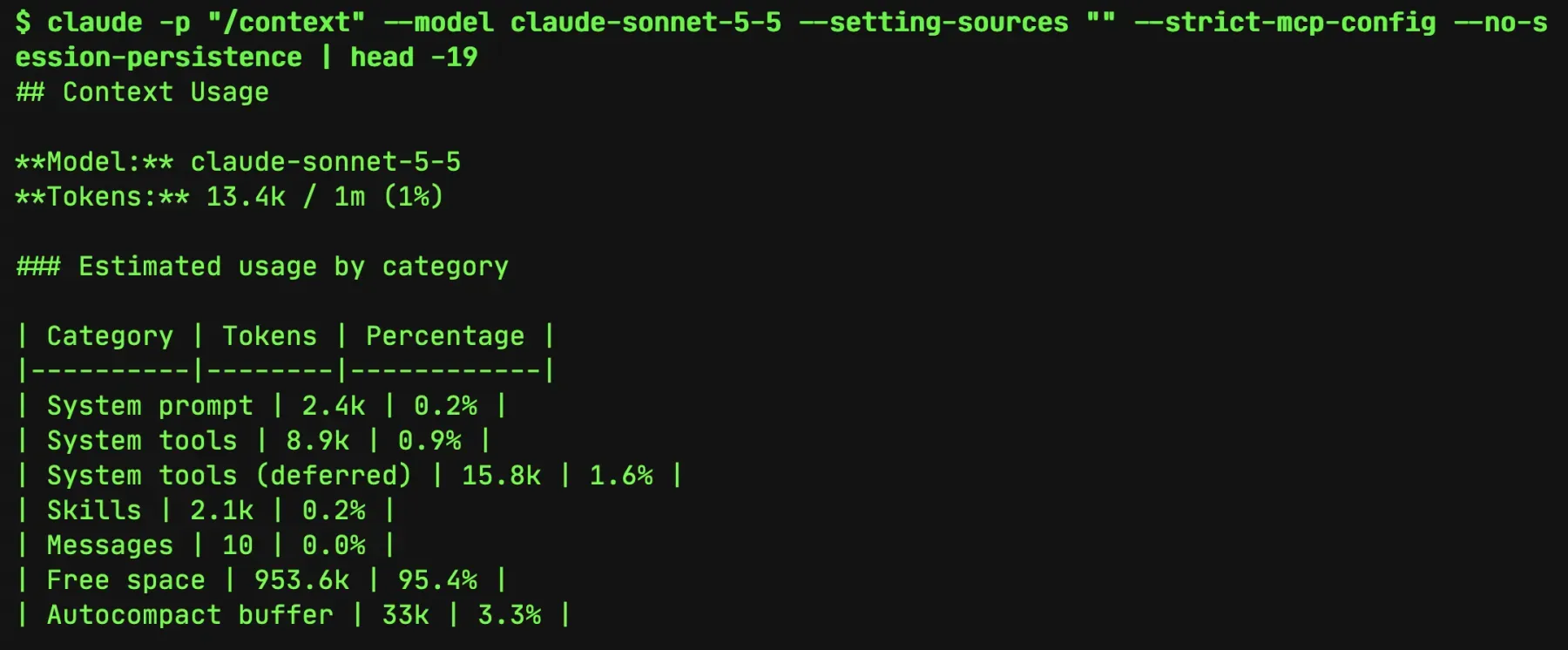
That block goes out again with every request, but it's cached, and a cache read costs a twentieth of fresh input on Sonnet 5.5. Two things on top of it behave very differently:
- A
CLAUDE.mdfile. Our 696-word sample project guide added 1,615 tokens to every request. Small per turn, but it's there on all of them, and it's written fresh whenever the cache is cold. - MCP servers. Ten tools added 158 tokens and forty added 608, about 15 tokens per tool. Claude Code sends only the tool names and loads a tool's full definition when Claude searches for it, a feature it calls tool search and turns on by default (Claude Code MCP docs, checked October 22, 2026).
So if you're trimming, trim CLAUDE.md before you uninstall MCP servers.
Why do subagents cost so much?
We added a short paragraph to the task asking for three subagents in parallel to read the three billing files before fixing anything. Same bug, same 8 hidden tests passed. The fix cost $0.276 instead of $0.108.
Each subagent starts its own conversation with its own prompt and tools, so it can't reuse the main session's cache. It also gets the five-minute cache even on a subscription (Claude Code caching docs, checked October 22, 2026). Then the main session reads all three reports. On this small task they bought nothing. The fix without subagents passed the same 8 tests.
The usual tip, setting CLAUDE_CODE_SUBAGENT_MODEL to Haiku, didn't reliably help. Claude Code's docs say the variable is only a default. A model Claude picks when it starts a subagent wins over it, and the built-in Explore subagent, which runs on your main model, ignores it (Claude Code subagent docs, checked October 22, 2026). That's what we saw. With the variable set to Haiku, one run used Explore and stayed on Sonnet ($0.280). The other started general-purpose subagents and asked for Haiku itself ($0.169, of which the three Haiku subagents were 1.3 cents).
Setting CLAUDE_CODE_SUBAGENT_MODEL_FORCE=1 as well fixed that. Both forced runs used Explore again, and this time Explore ran on Haiku. Each fix cost $0.201, and the subagents' share was 0.6 and 1.3 cents.
Even with Haiku doing the reading, the main Sonnet session alone cost more than the whole fix without subagents ($0.156 to $0.195 against $0.108). Reading three reports isn't free.
On Opus 5.5 the same request cost $0.784 for one fix, 7.3 times our Sonnet baseline. Opus costs twice Sonnet's price per token, and every subagent ran on Opus too. Forcing them onto Haiku cut it to $0.414, 47% less, and all 8 tests still passed. That's one run each.
What does coming back to an old session cost?
We started two sessions on the same fix and later asked each one a one-line question. We resumed the first after 19 minutes. Its first request read 28,312 tokens from the cache and wrote 641, and the whole follow-up cost $0.0063. We resumed the second after 66 minutes, when the cache had expired, so Claude Code wrote 15,512 tokens of the conversation again at the one-hour cache rate. The same question cost $0.0643, ten times as much.
On a subscription, Claude Code keeps the main conversation's cache for one hour while you're within your plan's usage, and five minutes on an API key (Claude Code caching docs, checked October 22, 2026). Our conversation was small. A 150,000-token session written again at $4 per million costs $0.60 on Sonnet before Claude answers (150,000 × $4 / 1,000,000), and twice that on Opus. From 200,000 tokens, Claude Code 2.1.299 and later compacts a conversation left idle in the terminal for about 54 minutes, before its cache expires (Claude Code changelog, checked October 22, 2026). Even our cold resume still read 13,259 tokens from the cache, the fixed prompt that our other runs had kept warm. Away from Claude Code entirely, that part would be written again too.
Does effort change the cost?
Yes, and the default is already the cheap setting. Claude Code runs Sonnet 5.5 at medium effort unless you change it (Claude Code model docs, checked October 22, 2026). We ran our baseline at high, to match our earlier model test. Medium cost $0.076 per fix in 4 turns, against $0.108 at high. Low cost more than medium, $0.094, because Sonnet took 12 turns instead of 4 and each turn reads the conversation again. Every run at every level passed all 8 hidden tests. That's two runs each on one small bug, so read it as "leave routine fixes on medium", not as a rule.
What we'd change in a setup that drains fast
- Don't ask for subagents on small tasks. When you do use them, set both
CLAUDE_CODE_SUBAGENT_MODEL=haikuandCLAUDE_CODE_SUBAGENT_MODEL_FORCE=1, or the built-in Explore subagent stays on your main model. Forcing also overrides the model set in your own subagent definitions. - Start fresh after a long break. After more than an hour away, a new session costs less than resuming a long one. Claude Code 2.1.304 and later warns before a resume that would use a noticeable share of your five-hour limit. If you'll come back, run
/compactbefore you leave, while the cache is still warm. - Keep
CLAUDE.mdshort. About 1,600 tokens per 700 words, on every request. - Leave your MCP servers. They cost names, not definitions, until Claude uses them.
- Keep Sonnet on medium effort for routine fixes. It's the default, and high cost about 40% more per fix in our runs.
- Pick the model first. It's still the biggest lever. On this same bug, Haiku 5.5 fixed it for $0.016 and Opus 5.5 for $0.331 in our Claude 5.5 cost test.
If an agent runs while you're away, set a spend cap as well. We covered what happens when one runs all night. And if your limit still drains on a setup like this, tell us what you're running on X at @devtoolpicks.
Get honest tool comparisons in your inbox
Join 50+ indie hackers and solo developers who get new comparisons, pricing changes, and tool picks. No spam. Unsubscribe anytime.
Related Articles

OpenCode vs Claude Code: Same Sonnet 5.5 Fix, Fewer Tokens in OpenCode
Same model, same bug, nearly the same code. The bill differed by a third, and mo...

Best AI Coding Agent Security Tools for Indie Hackers in 2026
A Cursor agent deleted a production database in 9 seconds. Here is what actually...

Anthropic Academy: Which Free AI Courses Are Worth Taking for Indie Hackers in 2026?
Anthropic quietly launched a free learning platform in March 2026 with 17 course...