Gemini 4 Argon vs Claude Sonnet 5.5: Cheaper per Call, 3x the Cost per Bug Fix
Same price per token as Claude Sonnet 5.5. Very different bills once you count tokens, thinking, caching and an agent loop.

Google priced Gemini 4 Argon at $2 per million input tokens and $10 per million output tokens until November 30, then $4 and $20 (Google's pricing page, checked October 15, 2026). That's exactly Claude Sonnet 5.5's price today, and from December it matches Opus 5.5 (Anthropic pricing, checked October 15, 2026).
Same price per token, then. So does it matter which one a SaaS calls? We gave Argon the four jobs from our Claude 5.5 cost test and ran Sonnet next to it.
Argon matched Sonnet on every answer and was 23 to 33% cheaper per API call. But on a coding fix it cost three times as much, it can't cache a short prompt, and its price doubles in six weeks.
How we tested: On October 15, 2026 we sent the same 72 API calls to Gemini 4 Argon and Claude Sonnet 5.5 through OpenRouter (40 support tickets to route, 20 invoice emails to parse, 12 help-center questions), then had each model fix the same billing bug three times in OpenCode 2.0.29, judged by 8 hidden tests. Every Argon and Sonnet cost in the table is what OpenRouter billed. The Haiku and cached Sonnet figures come from our Claude 5.5 test, priced from its token counts, and the screenshots are ours.
The results side by side
| Gemini 4 Argon | Claude Sonnet 5.5 | |
|---|---|---|
| Routing, correct out of 40 tickets | 40 | 40 |
| Cost per 1,000 routing calls | $0.72 | $0.93 |
| Extraction, correct out of 120 fields | 120 | 120 |
| Cost per 1,000 extraction calls | $1.39 | $1.83 |
| Help-center answers, correct out of 12 | 12 | 12 |
| Cost per 1,000 answers, no caching | $3.88 | $5.81 |
| Bug fixed (8 of 8 hidden tests) | 3 of 3 runs | 3 of 3 runs |
| Average cost per bug fix | $0.22 | $0.08 |
| Time per bug fix | 3 to 3.7 min | 33 to 47 s |
| Median response time per API call | 3.2 to 3.7 s | 1.5 to 2.0 s |
Prices at Argon's launch rate, checked October 15, 2026. The API jobs ran at medium effort and the bug fix at high effort on both models.
For scale, Claude Haiku 5.5 did the same three API jobs in our earlier test for $0.06, $0.10 and $0.35 per 1,000 calls, within one item of both models here. If Haiku is good enough for a job, neither of these is the cheap option.
Why is Argon cheaper per call at the same price?
Google counts fewer tokens for the same text. Our routing prompt came to 301 tokens on Argon and 405 on Sonnet. The invoice emails were 362 against 451, and the help-center prompt 1,572 against 2,321. That's 20 to 32% fewer tokens before either model writes a word.
Argon's answers were a little shorter too (53 words on average against 61, billed as 74 output tokens against 117). On the three questions we built to have no answer, both models said the help center didn't cover them. Neither invented one.
One routing call, worked out:
- Argon: 301 × $2 per million + 11.6 × $10 per million = $0.00072, so $0.72 per 1,000 calls
- Sonnet: 405 × $2 per million + 12 × $10 per million = $0.00093, so $0.93 per 1,000 calls
At 100,000 routed tickets a month that's about $72 on Argon and $93 on Sonnet.
Why did the bug fix cost three times as much?
Thinking. Both models fixed both parts of the bug in every run (an event on the first of the month billed twice, and a Tokyo customer's late-night calls landing on the wrong invoice). Here are the hidden tests failing on the original code and passing on Argon's fix.
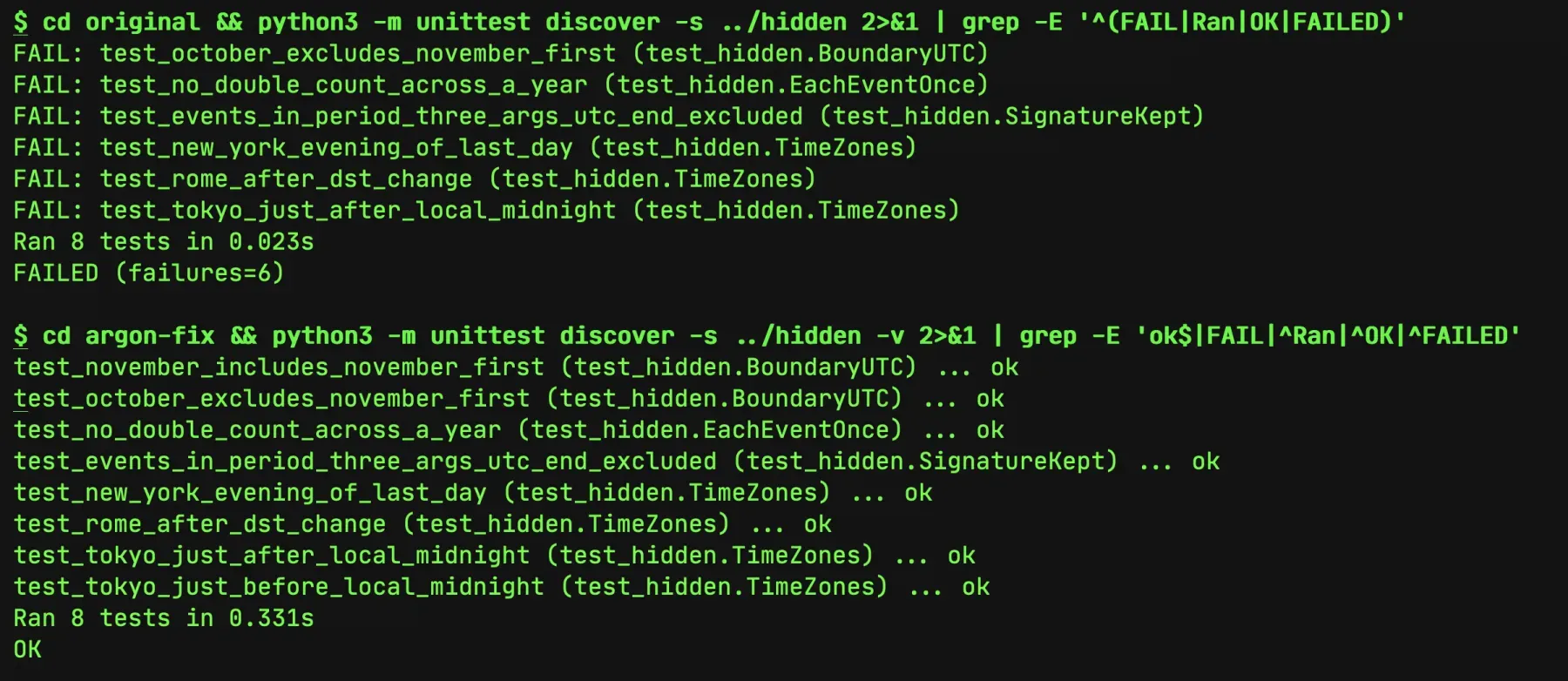
But Argon spent 9,160 to 15,848 thinking tokens per fix. Sonnet spent about 700. Google bills thinking as output ("Output price (including thinking tokens)" on the pricing page), so at $10 per million those tokens were about half or more of Argon's bill: 47 to 62% per fix (run 1, for example, 10,603 × $10 per million = $0.11 of its $0.22). Each fix cost $0.20 to $0.25 on Argon and $0.07 to $0.09 on Sonnet, and took 3 to 3.7 minutes against 33 to 47 seconds.
Argon also wrote fewer tests of its own (2 or 3 per run, against 4 or 5).
We ran both at high effort. Argon at a lower effort would likely think less and cost less, but we didn't measure that. At about 9,000 to 16,000 thinking tokens per task, that's roughly $0.12 of thinking per task at the launch price (mean 11,870 × $10 per million) and $0.24 from December, and we covered stopping a runaway agent session separately.
Where caching flips it to Claude
Argon only caches implicitly, and only from 4,096 input tokens. Explicit caching isn't supported at all (Google's caching docs, checked October 15, 2026). Claude 5.5 models cache any prompt from 512 tokens if you ask (Anthropic's caching docs, checked October 15, 2026).
Our help-center prompt was about 1,570 tokens on Argon, so it never cached. Not once in 12 calls.
On Sonnet the same help center is the cacheable part of every request. In our Claude test, pricing it at Sonnet's cache-hit rate came to $1.68 per 1,000 answers (cache writes left out), against Argon's $3.88. So for a SaaS that sends one short system prompt with every request (a support bot, a classifier with long instructions), Sonnet ends up cheaper than Argon at the same list price, as long as requests come often enough to keep Claude's 5-minute cache warm. A cache write costs $2.50 per million tokens, so by our numbers at least 6 in 10 requests must hit the cache. A quiet bot is still cheaper on Argon until November 30.
How fast was it at launch?
Slower, and busy. Through OpenRouter, Argon's median answer took 3.2 to 3.7 seconds against Sonnet's 1.5 to 2.0. Those times include OpenRouter's hop, so read them as relative, not as either vendor's own speed.
When we sent Argon's calls four at a time, 37 of the first 72 came back with HTTP 429 (Too Many Requests). Sonnet's 72 calls in the same few minutes had none. Argon's calls all went through on a second pass, one at a time with a pause between retries. Plan for rate limits if you build on it this month.
OpenRouter's own provider page shows the launch price and a half-price "flex" route that its standard routing doesn't use:
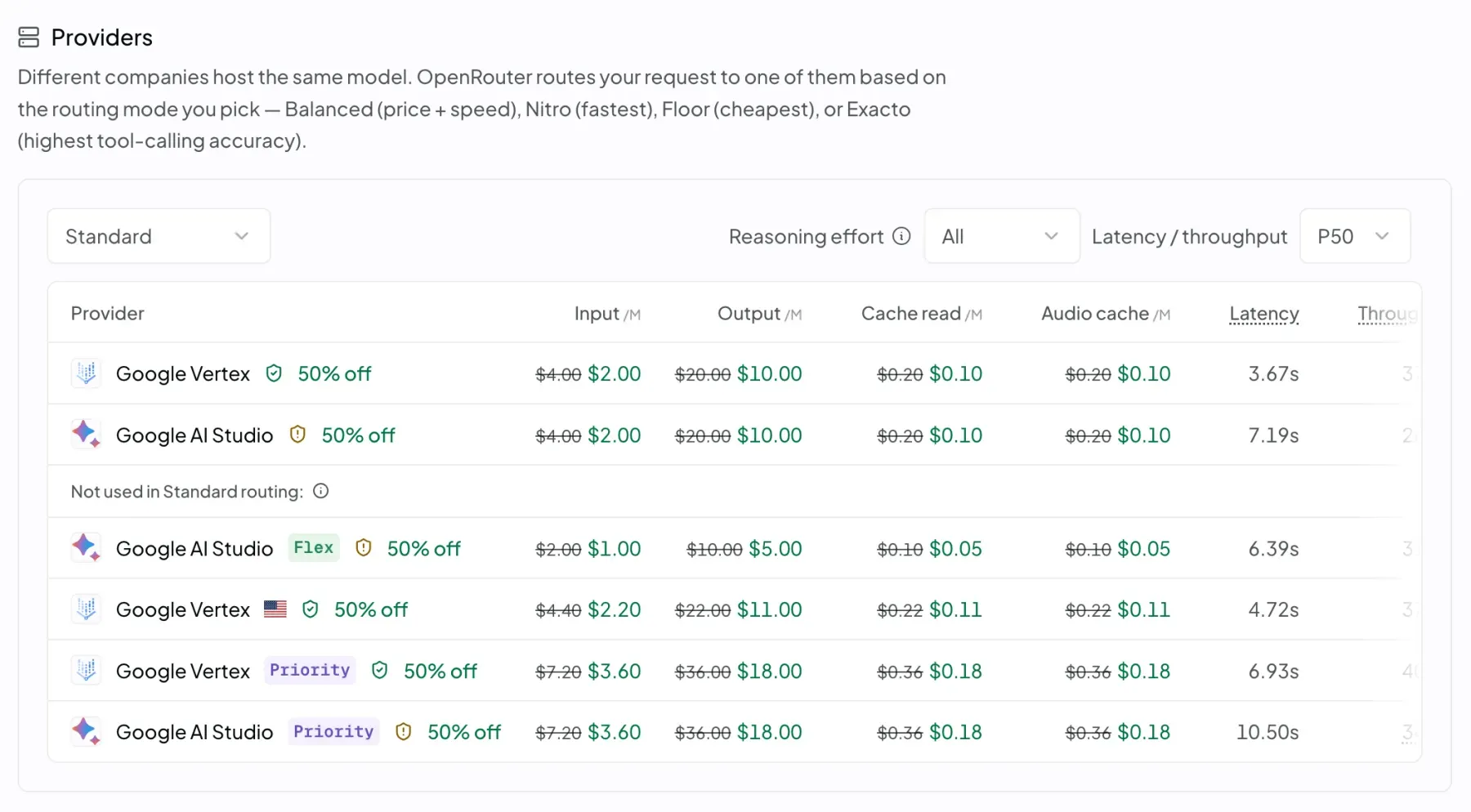
We pinned every Argon call to the standard Google AI Studio route, so our costs are the standard-route launch price, not the flex discount. Flex and Google's Batch API cost half, for work that can wait. We didn't test either.
What changes on December 1?
Argon goes to $4 and $20 per million tokens, which is Opus 5.5's price. Every Argon cost above doubles:
- Routing: $0.72 × 2 = $1.44 per 1,000 calls, against Sonnet's $0.93
- Extraction: $1.39 × 2 = $2.78, against $1.83
- Help-center answers: $3.88 × 2 = $7.76, against $5.81 uncached
From then on, Sonnet is cheaper than Argon on every job we ran, and Haiku is cheaper than both.
Which one we'd pick
Start with the cheapest model that gets your job right, then move up only where it fails.
- Routing, tagging, extraction: try Haiku 5.5 first. In our test it scored within one item of both models at a tenth of Argon's cost or less.
- Agent loops and coding: Haiku 5.5 fixed the same bug in our Claude test for $0.016, but needed about twice Sonnet's time in the model. If you're waiting on it, Sonnet 5.5, at a third of Argon's cost per fix and five times faster.
- One short prompt sent with every request: Sonnet with caching, when traffic keeps the cache warm. Argon can't cache it.
- One-off API calls before November 30: Argon saves 23 to 33% against Sonnet, if launch rate limits don't hurt you.
We compared Gemini's cheaper Flash line against Claude in an earlier post. If you've seen Argon win on a job of yours, tell us on X at @devtoolpicks.
Frequently Asked Questions
Is there a free tier for Gemini 4 Argon?
No. Google's pricing page says Gemini 4 Argon is not available on the Free tier or on the Google AI Pro plan (checked October 15, 2026). You need a paid Gemini API project, or a router such as OpenRouter, which is how we ran this test. Through November 30 it costs 2 USD per million input tokens and 10 per million output tokens, thinking included. From December 1 it is 4 and 20.
Should I switch from Claude Opus 5.5 to Gemini 4 Argon?
On our three API jobs both scored 40 of 40 routing tickets, 120 of 120 invoice fields and 12 of 12 help-center answers. Per 1,000 calls Argon cost 0.72, 1.39 and 3.88 USD, against Opus 5.5's 1.88, 3.59 and 13.33 uncached, so Argon stays cheaper even at its December price. The exception is a cached help center. Opus came to 4.64 USD per 1,000 answers there, cache writes left out, which beats Argon from December 1. Opus fixed our bug in Claude Code and Argon in OpenCode, so we can't compare their coding costs fairly.
Get honest tool comparisons in your inbox
Join 50+ indie hackers and solo developers who get new comparisons, pricing changes, and tool picks. No spam. Unsubscribe anytime.
Related Articles

Pinecone vs Weaviate vs Qdrant for Indie Hackers in 2026: Real Costs, Honest Verdict
All three vector databases now have real free tiers. Here is what each actually...

Claude Haiku vs Sonnet vs Opus 5.5: What Four SaaS Jobs Cost on Each
Routing, extraction, help-center answers and a bug fix, run on all three Claude...

Figma Just Launched a Design Agent: What Indie Hackers Need to Know
Figma launched a native AI Design Agent on May 20, 2026. It generates and edits...