GPT-6.1 Terra vs Claude Sonnet 5.5: Every Answer Right at a Third of the API Cost
We gave GPT-6.1 Terra the same 72 API calls and bug fix as Claude Sonnet 5.5. It matched every answer at about a third of the price per call.

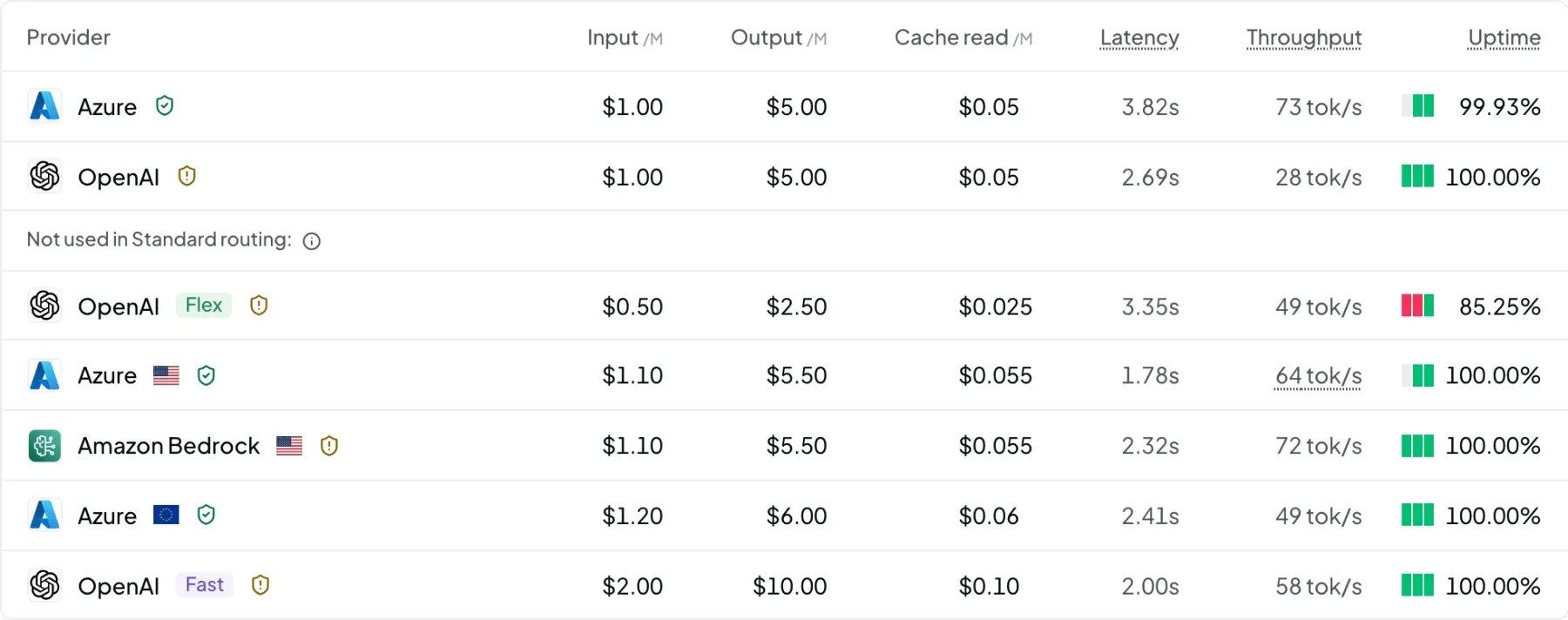
OpenAI's GPT-6.1 Terra lists at $1 per million input tokens and $5 per million output, half of Claude Sonnet 5.5's $2 and $10 (both checked November 4, 2026). In the r/codex launch thread, people kept asking the same thing. Why use it over Claude Opus 5.5?
We can't answer for Opus, but we can for Sonnet. We gave Terra the exact jobs Sonnet 5.5 did for us in October. It got all of them right. On the API jobs it cost 30 to 39% of what Sonnet did. On a real bug fix the saving shrank to a third, because Terra thinks a lot more before it edits.
How we tested: On November 4, 2026 we gave GPT-6.1 Terra the inputs Claude Sonnet 5.5 got from us on October 15. That was 72 API calls (ticket routing, invoice-field extraction and help-center questions) through OpenRouter on OpenAI's half-price flex route, at medium reasoning effort like Sonnet's runs, plus two runs of the same billing-bug fix in OpenCode 2.0.29, graded by 8 hidden tests. The Sonnet and Haiku figures come from the October runs, and the screenshot is ours.
What did each job cost per 1,000 calls?
Every figure here is the standard API price for the tokens each call used. Terra's calls went through OpenAI's half-price flex tier on OpenRouter to keep the test cheap, and we doubled the bill back to standard. Flex is exactly half of every standard rate, cache writes included, as OpenAI's pricing page shows under Flex/Batch.
| Job | GPT-6.1 Terra | Claude Sonnet 5.5 | Claude Haiku 5.5 |
|---|---|---|---|
| Route 40 tickets to one of 5 labels | 40 of 40, $0.36 | 40 of 40, $0.93 | 39 of 40, $0.06 |
| Pull 6 fields from 20 invoice emails | 120 of 120, $0.72 | 120 of 120, $1.83 | 119 of 120, $0.10 |
| Answer 12 help-center questions, no cache | 12 of 12, $1.76 | 12 of 12, $5.81 | 12 of 12, $0.35 |
| Same, with the help center cached | $0.47 | $1.47 | $0.15 |
| Fix a two-part billing bug | 2 of 2 fixed, $0.053 per fix | 3 of 3 fixed, $0.078 per fix | not run |
Costs are per 1,000 calls, except the bug fix, which is per fix. The Haiku figures come from our Claude Haiku vs Sonnet vs Opus 5.5 test, priced from its token counts. The cached Sonnet figure prices the October calls' own token counts with the 2,287-token help center at Anthropic's $0.10 cache-hit rate.
Terra didn't miss a single answer. On the three help-center questions the docs don't cover, it said so and pointed the customer to support instead of guessing. Its answers also added small details (the 09:00 send time for recurring invoices, SEPA for annual plans), and we checked each one against the help center. All were in it.
Where does the saving come from?
Two places, and only one of them is the price tag.
The first is price. Terra's per-token rate is half of Sonnet's.
The second is the tokenizer. Fed the same three prompts, OpenAI's tokenizer counted 33 to 36% fewer tokens than Anthropic's. The help-center prompt, for example, was 1,506 tokens for Terra and 2,321 for Sonnet.
Output went both ways. Terra wrote more on routing (20 tokens against 12, because it spent about 8 on reasoning first) and less on help-center answers (50 against 117). Half the price on about two-thirds of the tokens is how you land at 30 to 39%.
Does caching change the picture?
It widens the gap. Terra cached without being asked.
OpenAI caches long prompts automatically. 11 of our 12 help-center calls read 1,483 of their roughly 1,500 prompt tokens from the cache, which costs $0.05 per million instead of $1. Our test script sent no cache settings at all. That took Terra's help-center cost from $1.76 to $0.47 per 1,000 answers. Routing and extraction prompts are short, and none of those calls got a cache hit.
Claude only caches when the request asks for it with a cache_control field (Anthropic's pricing docs cover both ways to do it). Our Sonnet calls didn't ask, so they paid the full $5.81. Priced with the help center cached, the same October calls come to $1.47, still 3.2 times Terra's figure.
Both cached figures leave out cache writes. OpenAI's pricing page now lists a 30-minute cache write for Terra at $1.25 per million. Count our real bill, writes included, and Terra's cached help-center cost was $0.50 per 1,000. If you want the full mechanics, our prompt caching comparison measured them on Claude, GPT and Gemini.
How did it handle a real bug fix?
The task is the one we gave Sonnet in OpenCode in October: two support tickets about usage landing on the wrong invoice (a boundary bug and a time-zone bug), asking it to find the cause, fix it and add tests, graded by 8 hidden tests the model never sees. Same OpenCode version, same permissions, effort set to high.
Terra fixed both parts in both runs and passed all 8 hidden tests each time. It added 5 and 7 tests of its own, against 4 or 5 for Sonnet.
| Per fix | GPT-6.1 Terra (2 runs) | Claude Sonnet 5.5 (3 runs) |
|---|---|---|
| Cost at standard price | $0.045, $0.061 | $0.066, $0.082, $0.086 |
| Thinking tokens | 2,685, 2,718 | 753, 710, 737 |
| Model turns | 11, 12 | 5, 6, 7 |
| Cached tokens read | 74,429, 98,526 | 30,776, 47,837, 61,775 |
Terra thought about 3.7 times as much per fix and took about twice as many turns. Each turn adds to the cached conversation, and those cache writes ($1.25 per million) were about a third of each fix. On average a fix cost $0.053 against Sonnet's $0.078, two-thirds of the price, not a third.
We can't tell you which was faster. Terra's runs went through the half-price flex route, a different service tier from the standard API that Sonnet used, so its 69 and 128 seconds per fix don't compare. We stopped at two runs because they agreed, which is a small sample. Treat the per-fix figures as a direction, not a benchmark.
Which model should you use for which job?
- Routing, tagging, short extraction at volume: Claude Haiku 5.5 is the cheapest here by a wide margin ($0.06 per 1,000 routing calls). Terra is the pick only if Haiku's one miss in 40 matters to you more than a sixfold price difference.
- Help-center and RAG answers: Haiku 5.5 again, if 12 of 12 holds on your docs ($0.35 per 1,000 uncached). Between the mid-tier models, Terra wins clearly, and its caching works without any setup.
- Already paying for Sonnet on API jobs like these? Terra did every one of them right for about a third of the price. Run your own sample first, since our sample is 72 calls.
- Coding agents: Terra saved about a third per fix in our runs. Our earlier Gemini 4 Argon vs Claude 5.5 test showed how fast thinking tokens can erase a per-call saving, and Terra loses part of its own the same way.
- Using Terra inside Codex or ChatGPT plans: we didn't test subscription limits. Everything above is API pricing.
Ran Terra on your own workload and got a different ratio? Tell us on X at @devtoolpicks.
Get honest tool comparisons in your inbox
Join 50+ indie hackers and solo developers who get new comparisons, pricing changes, and tool picks. No spam. Unsubscribe anytime.
Related Articles

Prompt Caching on Claude, GPT and Gemini, Measured: Same Price, Different Bills
Claude Sonnet 5.5, GPT-6.1 Sol and Gemini 4 Argon list the same cache price. We...

Gemini 4 Argon vs Claude Sonnet 5.5: Cheaper per Call, 3x the Cost per Bug Fix
Same price per token as Claude Sonnet 5.5. Very different bills once you count t...

Best ChatGPT Pro Alternatives for Developers in 2026
Pro 200 keeps its $200 price but loses half its Codex usage on October 30. Here...