Qwen 3.7 Max vs Claude Sonnet 4.6 for Indie Hackers in 2026: The Frontier Model You Haven't Tried Yet
Qwen 3.7 Max is 50% cheaper on output than Claude Sonnet 4.6 and scores higher on math and reasoning. Here is where each model wins.
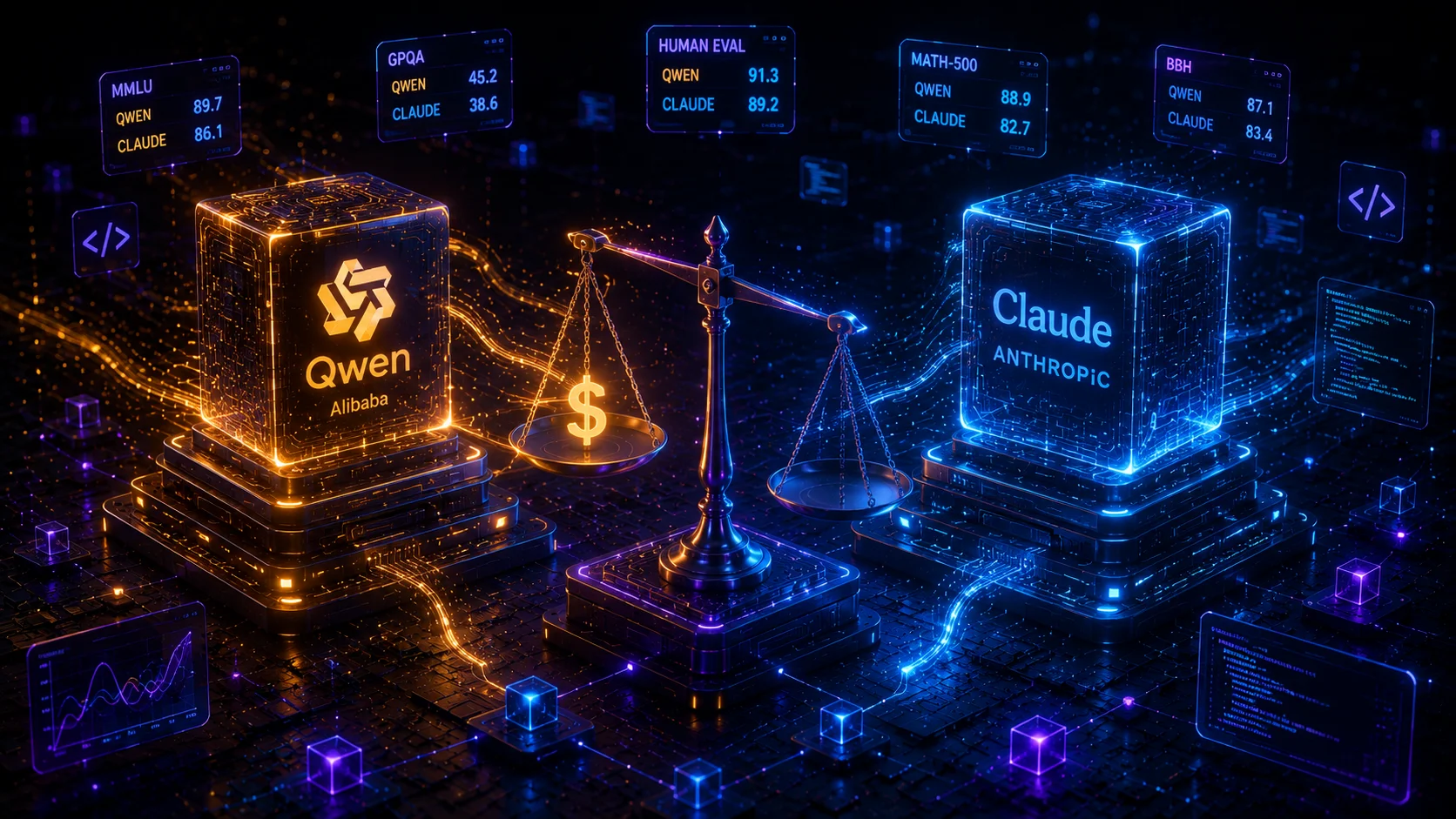
Alibaba just shipped Qwen 3.7 Max. It costs $2.50/$7.50 per million tokens. Claude Sonnet 4.6 costs $3/$15.
That output price is 50% cheaper. Not a minor difference. Not a rounding error. Half price.
Most indie hackers have never called a Qwen model. They stick with Claude, GPT, or Gemini because those are the names they know. But Qwen 3.7 Max scored 56.6 on the Artificial Analysis Intelligence Index at launch, placing it #5 among all measured models and ahead of Gemini 3.5 Flash. It posted 92.3% on GPQA Diamond and achieved the lowest hallucination rate of any frontier model at 22.9%.
So the question is not whether Qwen 3.7 Max is good. It is whether the ecosystem is mature enough for indie hackers to trust it in production.
My pick: Claude Sonnet 4.6 remains the safer default for most indie hackers. The coding benchmark lead, Claude Code integration, and Anthropic's established API reliability make it the lower-risk choice. But Qwen 3.7 Max is worth testing for math-heavy, reasoning, and document analysis workloads where the 50% output savings add up fast.
Quick Verdict
| Qwen 3.7 Max | Claude Sonnet 4.6 | |
|---|---|---|
| Input price | $2.50 / million tokens | $3.00 / million tokens |
| Output price | $7.50 / million tokens | $15.00 / million tokens |
| Cached input | $0.25 / million tokens | $0.30 / million tokens |
| Context window | 1M tokens | 1M tokens |
| Intelligence Index | 56.6 (#5 overall) | ~55 (estimated) |
| GPQA Diamond | 92.3% | ~90% |
| Hallucination rate | 22.9% (lowest) | Higher |
| Coding (BenchLM avg) | ~54 | ~66 |
| Open weights | No (API only) | No |
| Provider | Alibaba Cloud | Anthropic |
Compare pricing for both on our AI Models page or run your numbers through the AI API Cost Calculator.
What Does the 50% Output Saving Actually Mean?
Same scenario: 1,000 API calls per day, 1,500 input tokens, 800 output tokens.
Monthly cost with Qwen 3.7 Max:
- Input: 45M tokens x $2.50/M = $112.50
- Output: 24M tokens x $7.50/M = $180
- Total: $292.50/month
Monthly cost with Claude Sonnet 4.6:
- Input: 45M tokens x $3/M = $135
- Output: 24M tokens x $15/M = $360
- Total: $495/month
You save $202.50 per month with Qwen. That is $2,430 per year.
The saving comes almost entirely from the output side. Input pricing is close ($2.50 vs $3), but output pricing is where Qwen pulls ahead dramatically ($7.50 vs $15). If your workload is output-heavy (generating long responses, documents, code), the gap widens further.
Where Qwen 3.7 Max Beats Sonnet 4.6
Qwen is not just cheaper. It leads in several areas that matter for real SaaS workloads.
Math and scientific reasoning. Qwen scored 97.1% on HMMT 2026 February, the highest of any model tested. Its Apex Math score of 44.5% beats Claude Opus 4.6 Max at 34.5%. If your SaaS does financial calculations, statistical analysis, or scientific computation, Qwen produces more accurate results.
Hallucination rate. Qwen 3.7 Max has the lowest measured hallucination rate among frontier models at 22.9%. For SaaS features where factual accuracy matters (legal tools, medical triage, data analysis), this is a meaningful advantage. A model that hallucinates less needs fewer guardrails and produces fewer errors your users notice.
Speed. Qwen generates output at 197 tokens per second via Alibaba Cloud. That is fast for a frontier-tier model. Combined with a 14.7-second time to first token (the thinking step before generation begins), it handles real-time workloads well once it starts producing output.
Context window parity. Both models support 1M tokens. Neither charges a premium for long context. This is a non-factor in the comparison.
Where Claude Sonnet 4.6 Still Wins
Sonnet 4.6's advantages are not about raw benchmarks. They are about the ecosystem and practical coding experience.
Coding quality. On BenchLM, Sonnet 4.6 averages 66.4 on coding benchmarks compared to 54.1 for Qwen 3.6 (the closest comparable Qwen generation). That 12-point gap is substantial. Terminal-Bench Hard, which tests real terminal coding tasks, is where the biggest difference shows up. If your SaaS API calls involve code generation, refactoring, or review, Sonnet produces better results.
Claude Code integration. Sonnet 4.6 is the default model powering Claude Code. If you use Claude Code as your daily coding tool, your development workflow and your SaaS API run on the same model family. There is no equivalent coding agent for Qwen.
Instruction adherence. Sonnet follows complex multi-step prompts more reliably. If your system prompt says "respond in JSON, include these 5 fields, skip the field if empty, and add a confidence score between 0 and 1," Sonnet follows every instruction. Qwen 3.7 Max occasionally drops conditions or misinterprets edge cases in complex prompts.
API maturity and documentation. Anthropic's API has years of production hardening, extensive documentation, and a large community of developers building on it. Alibaba Cloud Model Studio is newer and less documented in English. SDK support, error handling patterns, and community resources are thinner for Qwen.
The Trust Question
This is the part nobody writes about, but every indie hacker thinks about.
Qwen 3.7 Max runs on Alibaba Cloud. Your API calls route through Chinese infrastructure. For many SaaS founders, this raises questions about data handling, privacy policies, and regulatory compliance.
If your SaaS handles sensitive user data (health, finance, legal), you should review Alibaba Cloud's data processing terms carefully before routing production traffic through their API. Some enterprise clients explicitly prohibit sending data to certain jurisdictions.
For non-sensitive workloads (content generation, public data analysis, general reasoning), this is less of a concern. The model runs the same way regardless of where the servers sit.
Using Qwen through OpenRouter adds one layer of abstraction, but the API calls still route to Alibaba Cloud's Model Studio as the upstream provider.
I am not making a judgment call here. Just flagging something you should evaluate for your specific situation before going to production.
One practical consideration: if you are building a SaaS that sells to European or American enterprise clients, they may ask which AI providers you use. "Anthropic's Claude" is a straightforward answer. "Alibaba's Qwen" may require more explanation. This does not affect the model's quality, but it can affect your sales conversations.
How to Cut Costs Further With Caching
Both models offer prompt caching at a 90% discount, but the base rates are different.
| Qwen 3.7 Max | Sonnet 4.6 | |
|---|---|---|
| Standard input | $2.50/MTok | $3.00/MTok |
| Cached input | $0.25/MTok | $0.30/MTok |
| Output | $7.50/MTok | $15.00/MTok |
With caching applied to the 1,000 calls/day scenario (assuming 1,000-token system prompt cached on every call):
Qwen 3.7 Max (cached): ~$12 input + $180 output = $192/month Sonnet 4.6 (cached): ~$14 input + $360 output = $374/month
Caching narrows the input gap (both become cheap), but the output gap stays the same because output tokens cannot be cached. The more output-heavy your workload, the more you save with Qwen.
Practical Scenarios: Which Model for Which SaaS Feature?
Customer support bot: Qwen 3.7 Max. Low hallucination rate means fewer wrong answers reaching your users. Output-heavy workload (long responses) benefits from the 50% output saving. Coding ability is not needed.
Code review tool: Claude Sonnet 4.6. The 12-point coding benchmark lead translates to measurably better code analysis. Instruction adherence matters when your prompt specifies review criteria.
Financial analysis dashboard: Qwen 3.7 Max. Strongest math benchmarks of any model in this price range. Reasoning ability handles complex multi-step calculations reliably.
AI writing assistant: Either works, but Qwen saves money. Writing quality is comparable between the two for non-technical content. Route to Sonnet if users are writing code documentation.
RAG pipeline over company documents: Qwen 3.7 Max for cost, Sonnet 4.6 for accuracy. Qwen's low hallucination rate is an advantage for factual retrieval. Sonnet's instruction adherence helps when the retrieval prompt is complex.
The pattern: if the task is math, reasoning, or document analysis, Qwen is the better value. If the task involves code or complex structured instructions, Sonnet wins regardless of price.
How to Test Qwen 3.7 Max Without Risk
The lowest-friction way to try Qwen 3.7 Max:
- Sign up for OpenRouter (if you do not have an account already)
- Call
qwen/qwen3.7-maxwith the same prompts you currently send to Claude Sonnet 4.6 - Compare output quality, latency, and token usage side by side
- Run 100 production-style calls through both models and measure the difference
You can also test for free on chat.qwen.ai during the preview period, though the free version has rate limits.
The key metric to track: not just which model produces "better" output, but which model produces output that is good enough for your specific use case at a lower cost. A model that is 90% as good at 50% of the price is the better business decision for most features.
How Qwen 3.7 Max Fits the Full Pricing Spectrum
This is the fourth post in our AI model comparison series. Here is how all seven models compare on the same 1,000-call/day workload:
| Model | Output per MTok | Monthly cost | Best for |
|---|---|---|---|
| Gemini 3.1 Flash Lite | $1.50 | $47 | Classification, extraction |
| Claude Haiku 4.5 | $5.00 | $165 | Coding, reasoning |
| Gemini 3.5 Flash | $9.00 | $284 | Agentic tools, speed |
| Qwen 3.7 Max | $7.50 | $293 | Math, reasoning, low hallucination |
| Claude Sonnet 4.6 | $15.00 | $495 | Code quality, Claude Code |
| Claude Opus 4.7 | $25.00 | $825 | Best coding, long tasks |
| GPT-5.5 | $30.00 | $945 | Reasoning, OpenAI ecosystem |
Qwen 3.7 Max sits between Gemini 3.5 Flash and Claude Sonnet 4.6 on cost, but its intelligence rating puts it closer to the flagship tier. That combination of mid-tier pricing and near-flagship quality is what makes it worth testing.
Final Verdict
Claude Sonnet 4.6 is still the right default for most indie hackers building with AI. The coding benchmarks, Claude Code integration, API maturity, and English-language documentation give it a practical edge that raw benchmark scores do not capture.
Qwen 3.7 Max is the model to watch. At $2.50/$7.50 with a 56.6 Intelligence Index and the lowest hallucination rate of any frontier model, it offers genuine frontier quality at mid-tier pricing. For math-heavy workloads, document analysis, and reasoning tasks where coding ability is not the bottleneck, routing to Qwen saves real money.
The smart play: keep Sonnet 4.6 as your primary model for coding and instruction-heavy tasks. Test Qwen 3.7 Max on a subset of your reasoning-heavy API calls. If the output quality holds up for your specific use case, you just cut your output costs in half on those calls.
Frequently Asked Questions
How much cheaper is Qwen 3.7 Max than Claude Sonnet 4.6?
Both charge similar input rates ($2.50 vs $3 per million tokens), but Qwen 3.7 Max charges $7.50 per million output tokens compared to $15 for Sonnet 4.6. That is 50% cheaper on output. At 1,000 API calls per day, Qwen costs about $293 per month compared to $495 for Sonnet.
Is Qwen 3.7 Max better than Claude Sonnet 4.6 at coding?
No. Claude Sonnet 4.6 has a stronger coding benchmark profile. On BenchLM, Sonnet averages 66.4 on coding tasks compared to 54.1 for the Qwen 3.6 generation. Sonnet also powers Claude Code, which gives it a tested and mature coding workflow. Qwen 3.7 Max is stronger on math and scientific reasoning.
Can I use Qwen 3.7 Max with OpenRouter?
Yes. OpenRouter began routing Qwen 3.7 Max on May 21, 2026 at $2.50/$7.50 per million tokens through Alibaba Cloud Model Studio. You can call it with the same OpenRouter API key you use for Claude and GPT models, making it easy to test alongside your existing setup.
Is Qwen 3.7 Max open source?
No. Unlike earlier Qwen models (Qwen 3.5 and 3.6 which have Apache 2.0 open weights), Qwen 3.7 Max is API-only with no published weights. If you want self-hosted Qwen, use Qwen 3.6 which is available on Hugging Face. Alibaba has not announced a timeline for open-sourcing 3.7.
Should indie hackers switch from Claude Sonnet 4.6 to Qwen 3.7 Max?
Not as a full replacement, but as a complement. Route math-heavy, reasoning, and document analysis tasks to Qwen 3.7 Max at $7.50 per million output tokens. Keep coding, Claude Code work, and instruction-heavy tasks on Sonnet 4.6. The 50% output saving on Qwen makes this worth testing for specific workloads.
Get honest tool comparisons in your inbox
Join 50+ indie hackers and solo developers who get new comparisons, pricing changes, and tool picks. No spam. Unsubscribe anytime.
Related Articles

Best ChatGPT Pro Alternatives for Developers in 2026
Pro 200 keeps its $200 price but loses half its Codex usage on October 30. Here...

Gemini 3.5 Flash vs Qwen 3.7 Max for Indie Hackers in 2026
These two mid-tier flagships cost almost exactly the same per month. The choice...

Best Claude Model for Solo Developers in 2026
Four Claude models, a 10x price spread, one clear answer for solo devs. The hone...