Vercel vs Cloudflare Workers for a Next.js App: $20 vs $5 a Month, Then Up to $120 vs $5 at 3 Million Views
We measured one Next.js app in Node and in Cloudflare's local runtime, then priced it on Vercel and Workers at three traffic levels.

A developer asked on X on November 8 whether Cloudflare's $5 plan is enough when you pay $20 a month for Vercel. The answer has little to do with compute.
For a small Next.js app, both bills stay flat for a long time. We priced ours at $20 a month on Vercel Pro and $5 on Workers Paid up to 300,000 page views. At 3 million views, Vercel costs up to $120 and Workers is still $5. The difference isn't the server rendering. It's the JavaScript files.
How we tested: On November 12, 2026 we built one Next.js 16.4.6 app, ran it with
next startand as a Cloudflare Worker in Wrangler's local runtime, and measured CPU time and bytes per page view. Then we priced it at three traffic levels from Vercel's and Cloudflare's pricing pages, captured the same day. We didn't deploy to either platform, so the bills are list prices applied to these measurements. The screenshots are ours.
What does the same Next.js app cost on each?
The app is a fresh create-next-app project with one page that renders a 50-row table on the server on every request. Each page view loads the HTML (4.7 KB gzipped) plus 7 JavaScript and CSS files (179 KB gzipped). We count every view as a first visit that downloads all 7 files, so these bills are a ceiling. Returning visitors keep the files in their browser cache.
| Page views a month | Vercel Hobby | Vercel Pro | Cloudflare Workers Free | Workers Paid |
|---|---|---|---|---|
| 30,000 | $0, non-commercial use only | $20 | $0 | $5 |
| 300,000 | Over the 1M CDN request limit | $20 | $0 | $5 |
| 3,000,000 | Over four limits | Up to $120 | At its 100,000 a day request limit | $5 |
Vercel Pro is $20 a month per developer seat and includes $20 of usage credit (checked November 12). Our app used $1.34 of that credit at 30,000 views and $13.38 at 300,000, so the bill stayed at $20. Workers Paid is $5 a month per account and includes 10 million requests and 30 million CPU milliseconds. Our app never left that allowance.
Vercel's rates are for Washington, D.C. (iad1), its default function region.
Why does Vercel's bill grow when the server barely works?
Count the requests. One page view on our app is 1 server-rendered HTML request and 7 static file requests, and Vercel bills all 8 as CDN requests.
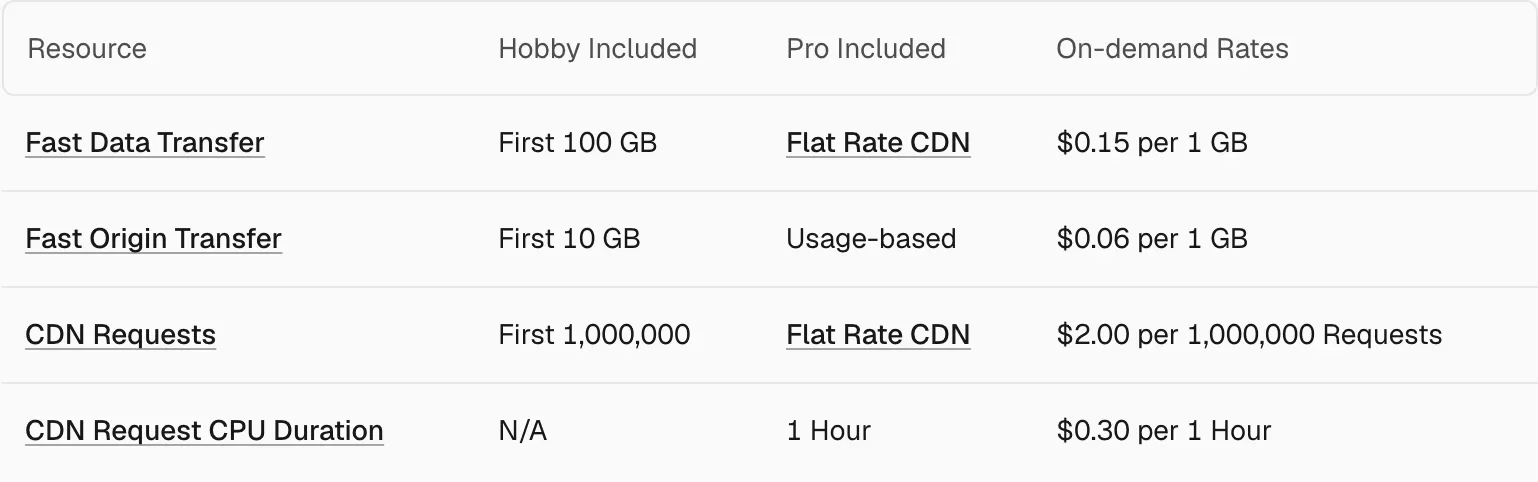
Here's Vercel Pro at 3 million views, billed on demand:
| Line | Usage | Cost |
|---|---|---|
| CDN requests | 24 million at $2.00 per million | $48.00 |
| Fast Data Transfer | 551 GB at $0.15 per GB | $82.61 |
| Function invocations | 3 million at $0.60 per million | $1.80 |
| Fast Origin Transfer | 14 GB at $0.06 per GB | $0.84 |
| Active CPU | 3.5 hours at $0.128 per hour | $0.45 |
| Provisioned memory | 6 GB-hours at $0.0106 per GB-hour | $0.06 |
| Total usage (lines rounded) | $133.77 |
The $20 credit covers the first $20 of usage, so the bill is $20 for the seat plus $113.77, or $133.77. The function lines, which pay for rendering the page, add up to $3.16. The other $130.61 is CDN requests and data transfer, and most of both is the 179 KB of JavaScript and CSS.
Cloudflare doesn't bill those files at all.

So on Workers, only the 3 million HTML requests count, and the Workers Paid plan has no data transfer charges either.
Does Flat Rate CDN help?
At high traffic it does. Flat Rate CDN is a Pro option that swaps per-request CDN billing for a monthly tier. You turn it on in your team's billing settings.
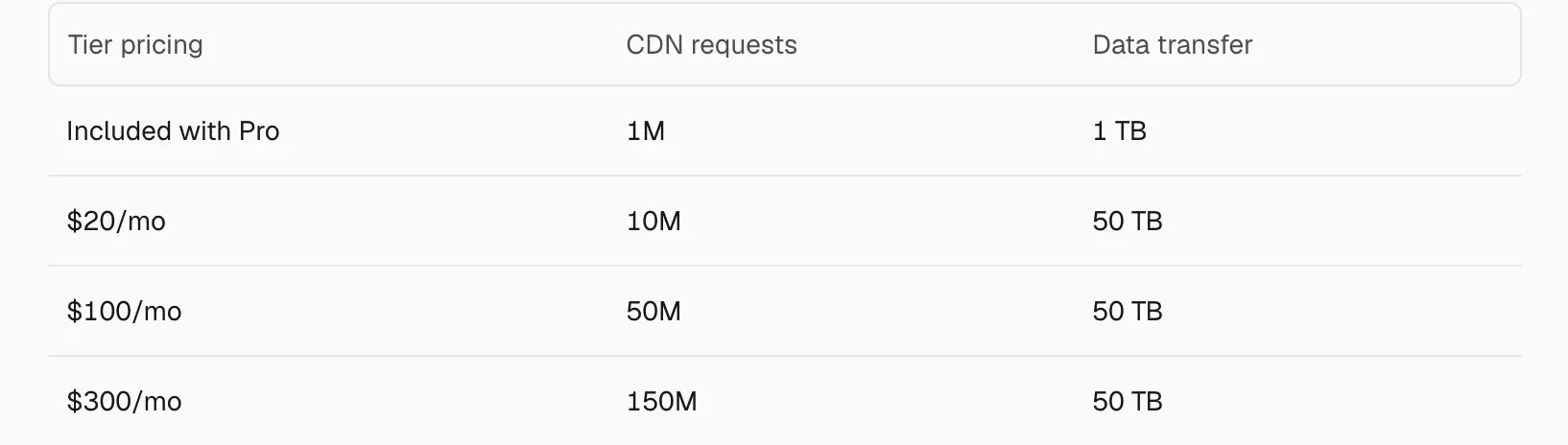
Our 24 million CDN requests at 3 million views fit the $100 tier. The function lines ($3.16) stay inside the $20 credit, so the bill is $120 instead of $133.77. That assumes the credit doesn't pay the tier fee. Vercel's Pro plan docs say the credit covers usage from the first unit and don't mention tier fees. If it does cover them, the bill is $103.16.
At 300,000 views it's the wrong choice. The 2.4 million requests need the $20 tier, which makes $40, while on-demand billing stays at $20.
If most of your visitors are in Europe, the request rate is higher. Vercel lists CDN requests at $2.60 per million in Frankfurt (fra1), checked November 12.
Is Vercel Hobby enough for a side project?
Only if it makes no money.

Vercel's fair use guidelines count payments, ads (AdSense included), selling a product and affiliate-led sites as commercial. Donations are fine. A side project with a Stripe checkout needs Pro from day one.
Then there's the request limit. Hobby includes 1 million CDN requests a month, and our app uses 8 per page view, so it covers about 125,000 views. The 100 GB data transfer limit would last to about 545,000. And going over doesn't send a bill. Vercel's Hobby docs say that in most cases you wait until 30 days have passed before you can use the feature again.
We found no commercial-use rule on Cloudflare's Workers pricing page. Workers Free limits you per day and per request instead.
How close does Workers get to its CPU limits?
Closer than we expected. Under next start our page used 4.08 ms of CPU per request, one request at a time. The same app built for Workers with the OpenNext adapter used 9.64 ms in wrangler dev, Cloudflare's local runtime, and 6.79 ms with 10 requests in flight. Local development mode adds overhead, so production may run lower. We priced Workers at the 9.64 ms figure anyway.
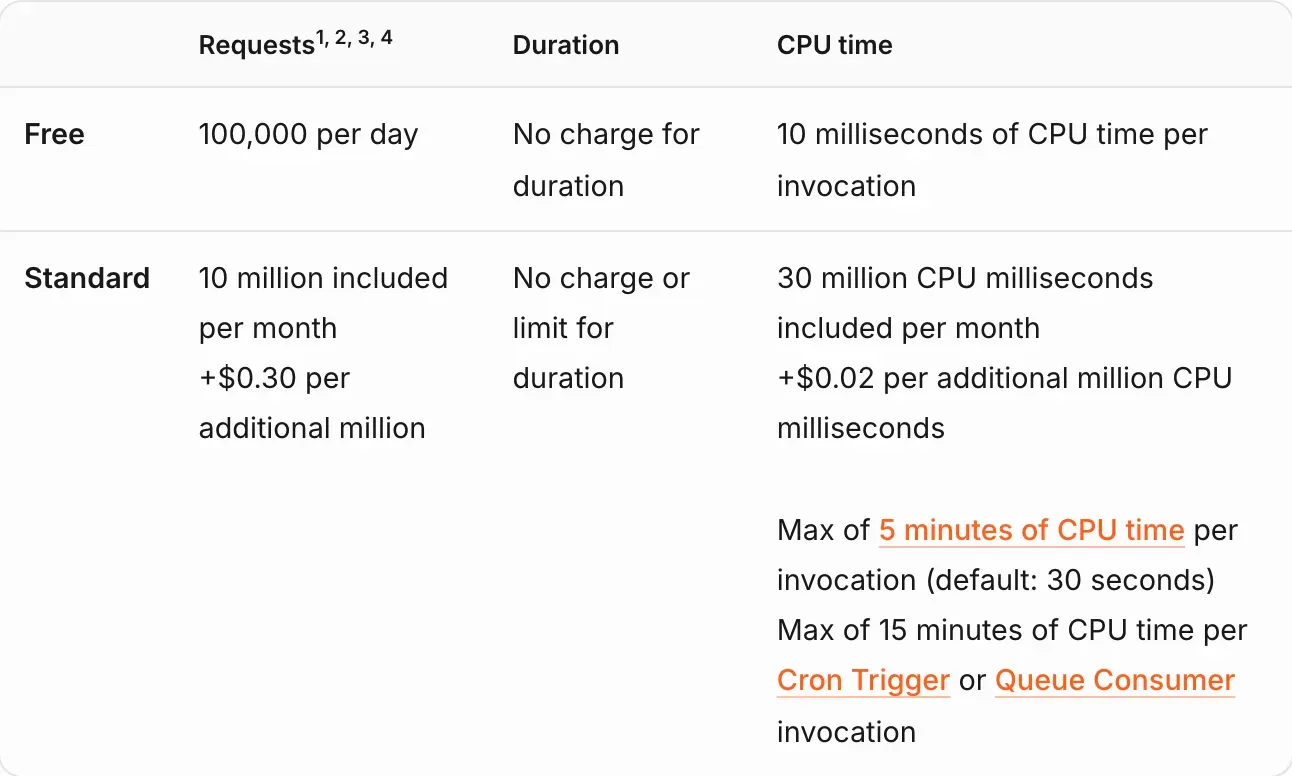
On Workers Free, the limit is 10 ms of CPU per invocation. Our 9.64 ms leaves almost no room. A page that renders more, or runs heavier code per request, can cross it, and Cloudflare then returns Error 1102 to the visitor. The other Free limit is 100,000 requests a day, reset at midnight UTC. At 3 million views a month that's the average day, so a busier day runs out, and Cloudflare returns Error 1027 (or skips the Worker if the route fails open) until midnight UTC.
On Workers Paid, 3 million requests at 9.64 ms each is 28.9 million CPU ms, just inside the 30 million included. Past that, extra CPU costs $0.02 per million ms, so the bill moves by cents, not dollars.
Our page doesn't wait on a database. A real one does, and the platforms bill that wait differently. Workers charges nothing for duration. Vercel bills provisioned memory for as long as a request is in flight. At 2 GB, 100 ms of database wait on 3 million requests is at most 166.7 GB-hours, or $1.77 at $0.0106. That's real, but small next to the CDN lines.
What broke when we moved the app to Workers?
The default config. create-next-app 16.4.6 turns on cacheComponents. With it on, our server-rendered page built and ran fine under next start. Built with OpenNext 1.20.16 and run in wrangler dev, every request to it failed with "The Workers runtime canceled this request because it detected that your Worker's code had hung".
We turned cacheComponents off and marked the page export const dynamic = "force-dynamic", the older way to render on every request. We measured both runtimes on that version, and every request returned 200. We didn't dig into why the first version hung, so we can't say whether it's OpenNext, Wrangler's local runtime or our page. But next start ran it, so test Next.js's newer features on Workers before you rely on them.
So is the $5 plan enough?
For this app, yes, with room to spare.
- Non-commercial project, modest traffic: Vercel Hobby or Workers Free, both $0. Hobby stops at about 125,000 views a month on an app like ours. Workers Free stops at 100,000 server-rendered requests a day, with little CPU headroom.
- Commercial side project, under about 300,000 views: Workers Paid at $5 if you're happy running Next.js through OpenNext. Vercel Pro at $20 if you'd rather skip the adapter, and the credit covers your usage at that size.
- Over a million views a month: Workers. Static files are free there, and on Vercel they're most of the bill.
- A team of three: Vercel Pro is $20 per developer seat, so $60 before usage. Workers Paid is $5 per account.
If you're comparing Vercel with servers you run yourself, our Vercel vs Railway vs Hetzner guide covers that, and our Railway alternatives priced post prices a small backend with a database on six hosts. For uptime, we counted 12 weeks of status-page incidents on Vercel, Railway, Render, Fly.io and Heroku. More options are in our Vercel alternatives.
Running a Next.js app on Workers and seeing different CPU numbers in production? Tell us on X at @devtoolpicks.
Get honest tool comparisons in your inbox
Join 50+ indie hackers and solo developers who get new comparisons, pricing changes, and tool picks. No spam. Unsubscribe anytime.
Related Articles

Leaving Railway? A Small Backend Costs $20 to $59 a Month on Other Managed Hosts
We measured what a small app and its Postgres database use, then priced the same...

Astro vs Next.js vs Eleventy for Content Sites in 2026
Astro, Next.js, or Eleventy for your blog or marketing site? An honest 2026 comp...

Bun vs Node vs Deno for Indie Hackers in 2026
The 'Bun is 4x faster' charts fall apart in real apps. Here's how Bun, Node, and...