Which Payment Providers Accept AI Image and Video Apps? Six Providers' Policies, Read
Reports on X say Polar has stopped taking AI image and video apps. We read six payment providers' policies to see who takes one, and on what terms.

Polar's acceptable use policy has listed "AI Content Generation tools (text, image, video, voice)" among businesses that "may not be accepted" since at least June 2026, and the version in force since October 1 adds what approval depends on, including business maturity and funding. On October 25 a founder posted on X that Polar had told them it no longer works with companies generating AI videos, and that they had moved to Dodo Payments.
So where can an AI image or video app take payments now? We read the policies of six providers to find out. No provider bans the category outright, but most of the merchants of record (the companies that sell to your customer and handle the tax) put a review in front of it. For a brand-new app, Dodo and Paddle are the likeliest yes, and plain Stripe has the fewest written AI rules if you handle tax yourself.
How we tested: On October 27, 2026 we read and saved the acceptable use policies, prohibited product lists and AI review pages of Polar, Paddle, Lemon Squeezy, Creem, Dodo Payments and Stripe, and took every policy screenshot below ourselves. The Polar dashboard screenshot comes from our own sandbox account, created on October 21, and the Lemon Squeezy signup details from our tester's run on October 22.
Who takes an AI image or video app?
| Provider | Who sells to your customer | AI image and video generators | Named as banned | Extra for AI apps | Headline fee |
|---|---|---|---|---|---|
| Polar | Polar | Closer review, may not be accepted | Face swaps, deepfakes, adult AI content, AI relationship apps | May ask for more information, safeguards or contract terms | 5% + 50¢ on the free plan |
| Paddle | Paddle | Not named. Checks before approval | Face swaps, deepfakes, voice impersonation, likeness without consent | Human-like faces are a restricted category | 5% + 50¢ |
| Lemon Squeezy | Lemon Squeezy | Not mentioned | Sexual content, NSFW chatbots, unlicensed content | None listed | 5% + 50¢ |
| Creem | Creem | Strict due diligence, proven track record required | Face swaps, deepfakes, AI companions | Moderation API required, branding and disclosure rules | 3.9% + 40¢ |
| Dodo Payments | Dodo Payments | Often reviewed, approval not guaranteed | Adult AI content, AI companions, face-swap features | Moderation API available, on by default | 4% + 40¢ for US cards |
| Stripe | You | Not named | AI-generated adult content | You handle sales tax and VAT yourself | 2.9% + 30¢ for US cards |
| Stripe Managed Payments | Stripe | A listed tax code names image generators | Stripe's restricted list applies | Eligibility review | 3.5% on top of Stripe's fees |
Fees are each provider's headline card rate, checked on October 27, 2026, before international, payout and currency extras.
Does Polar still take AI generation apps?
Polar's acceptable use policy puts AI content generation next to eBooks, VPNs and ticket sales in its restricted group. Approval depends on "business maturity, ownership and funding, safeguards, and risk profile", and Polar may ask for extra terms before saying yes.
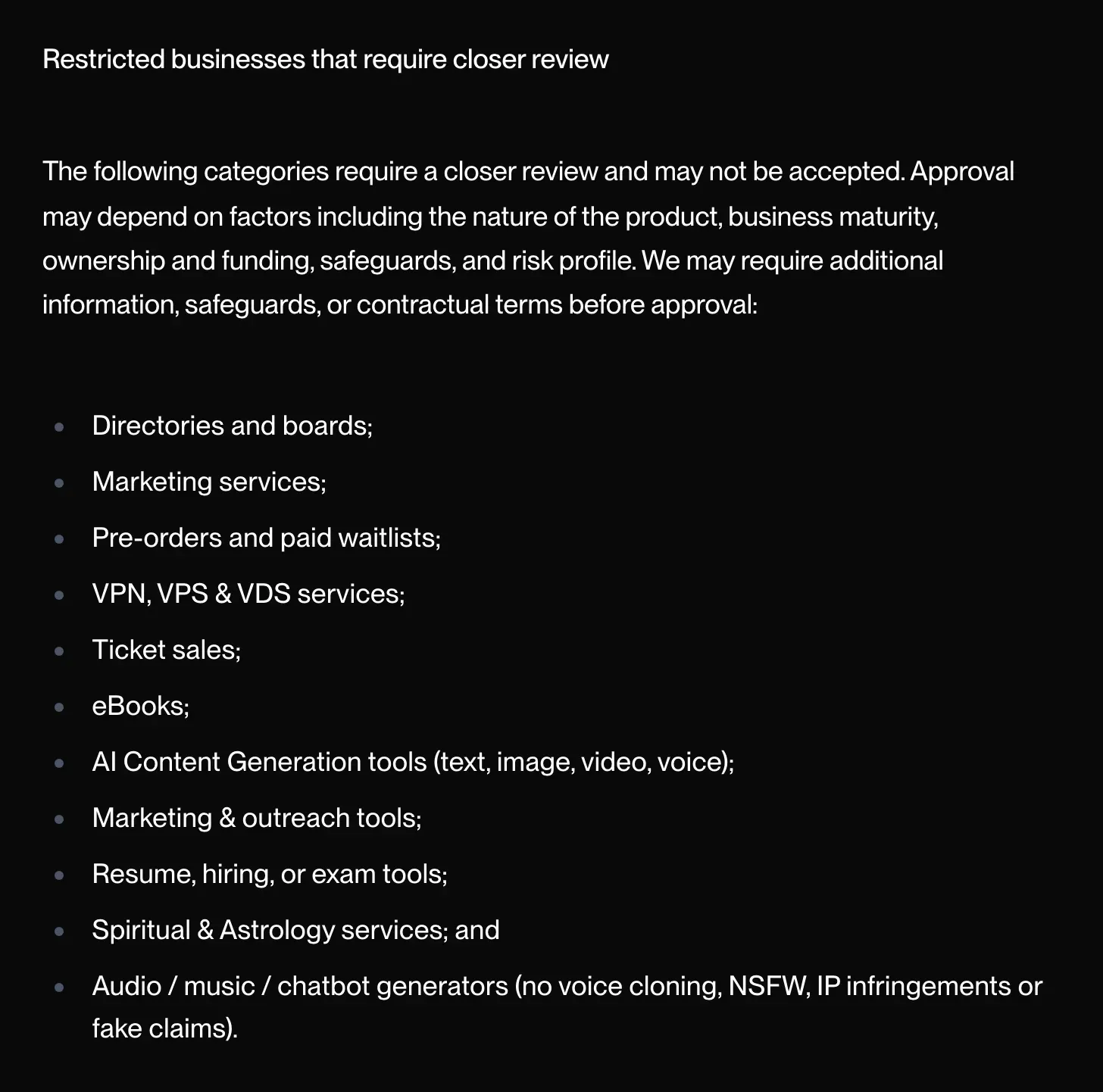
The list says text, image, video and voice, so an AI writing tool is in the same group as a video generator. The outright bans are narrower. They cover generation that infringes trademarks or copyrights, enables face swaps or deepfakes, or produces adult content, plus AI relationship services.
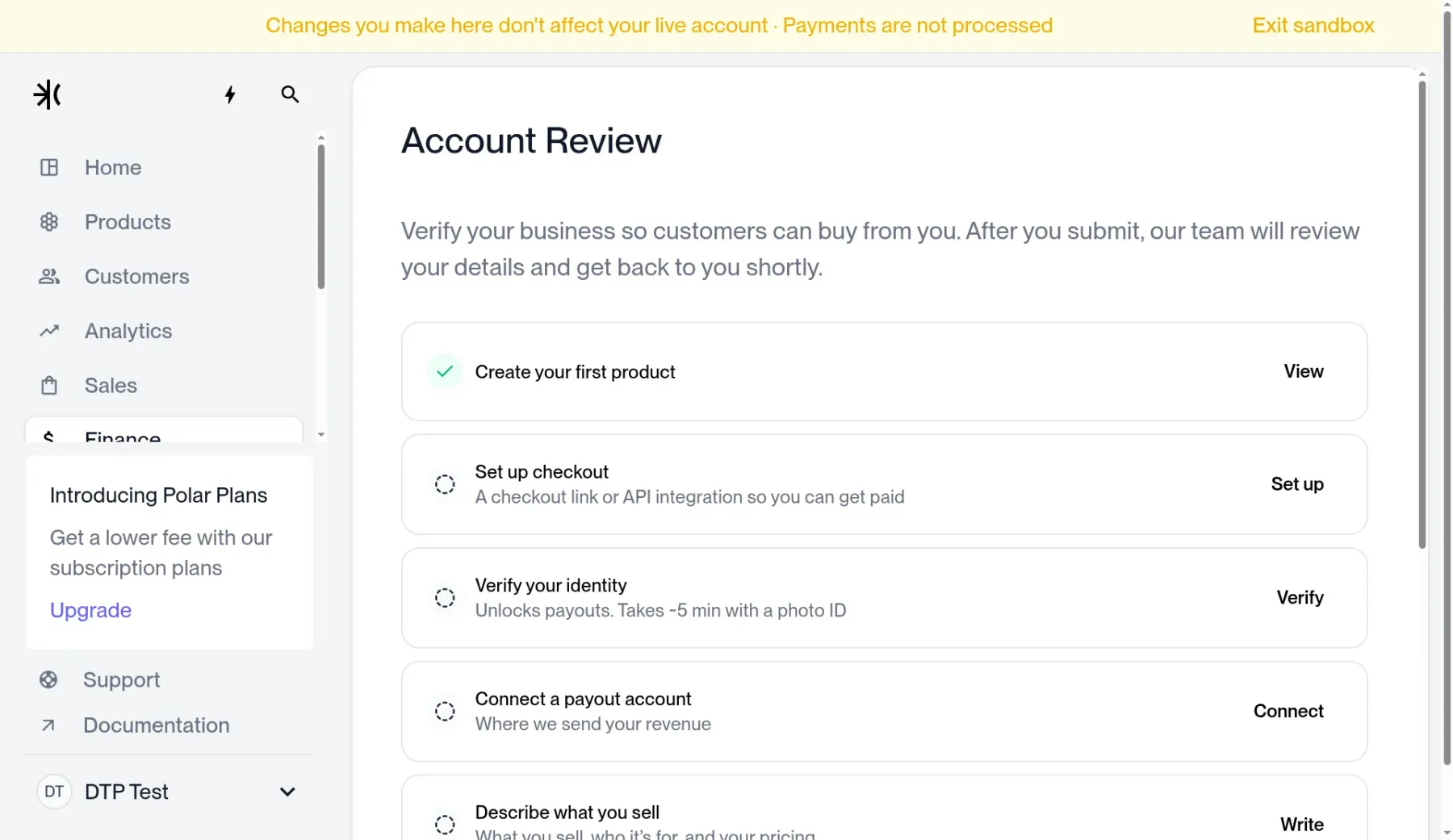
Every Polar seller passes an Account Review before going live. In our own Polar sandbox, that meant a page asking us to describe what we sell, add a website and a support email, and verify identity with a photo ID, then submit it for Polar's team to check.
The founder's post above shows the other side of it. An AI video app that was already selling through Polar was asked to leave. A second X user quoted a Polar message on October 16 saying it "can no longer support products that offer AI image or video generation". Neither is a public statement from Polar, so treat them as reports. They go further than the written policy, which lists the category for closer review rather than banning it.
Paddle: deepfakes out, image generation checked
Paddle's acceptable use policy, last updated April 13, 2026, has a "Content generation" entry on its forbidden list. Face swaps, deepfake images or videos, voice impersonation and any use of a person's likeness without consent are out. So is automated decision-making or categorization of people.
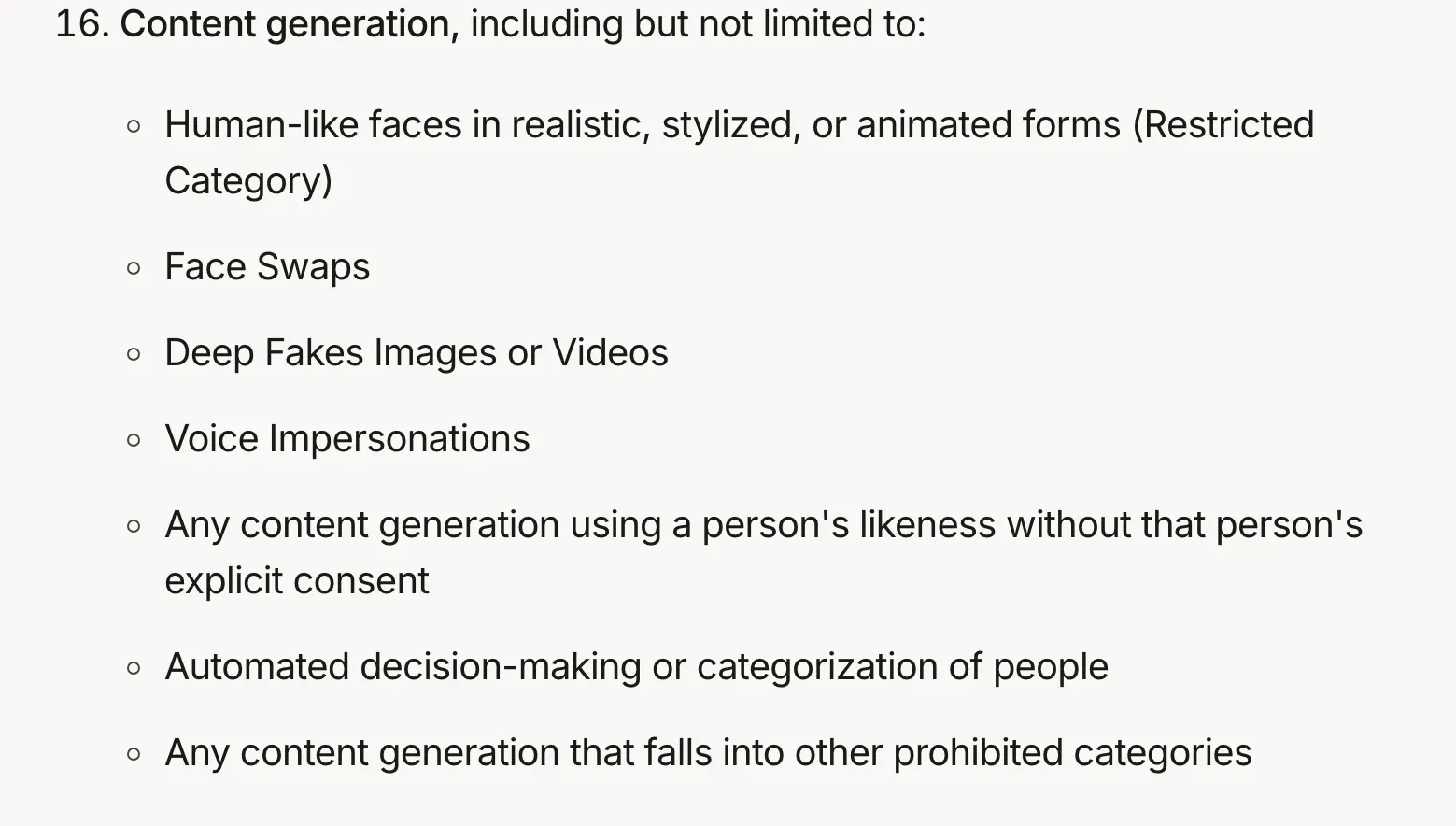
"Human-like faces in realistic, stylized, or animated forms" is marked as a restricted category, which means Paddle runs extra due diligence on it. An avatar, headshot or anime portrait generator falls right into it.
Plain image generation isn't on the list at all. Paddle's July 2025 blog post says it may still work with software that allows image generation, after checks, and may ask you for more information during them.
Lemon Squeezy: no AI rule, and a push toward Stripe
Lemon Squeezy's prohibited products list has no AI generation entry. The AI-adjacent items are sexual content "including NSFW chatbots" and products you don't hold the license or IP rights for. Deepfakes and face swaps aren't named. It also bans any product its payment processing partners restrict, which brings Stripe's list in.
That still reads like the easiest door here. But Lemon Squeezy's team now builds Stripe Managed Payments, and its January 2026 update says its goal is an easy way for users to migrate there. When our tester started a Lemon Squeezy signup on October 22, the form said "Managed Payments is the best fit" and offered Stripe first. For a new AI app, Stripe's rules (below) are the ones to plan for.
Creem: the strictest rules for a new AI app
Creem has written more about AI apps than anyone else on this list, and almost all of it is a requirement. Its account review page puts "Generative AI products, including, but not limited to text-to-image and text-to-video generation tools" under strict due diligence.
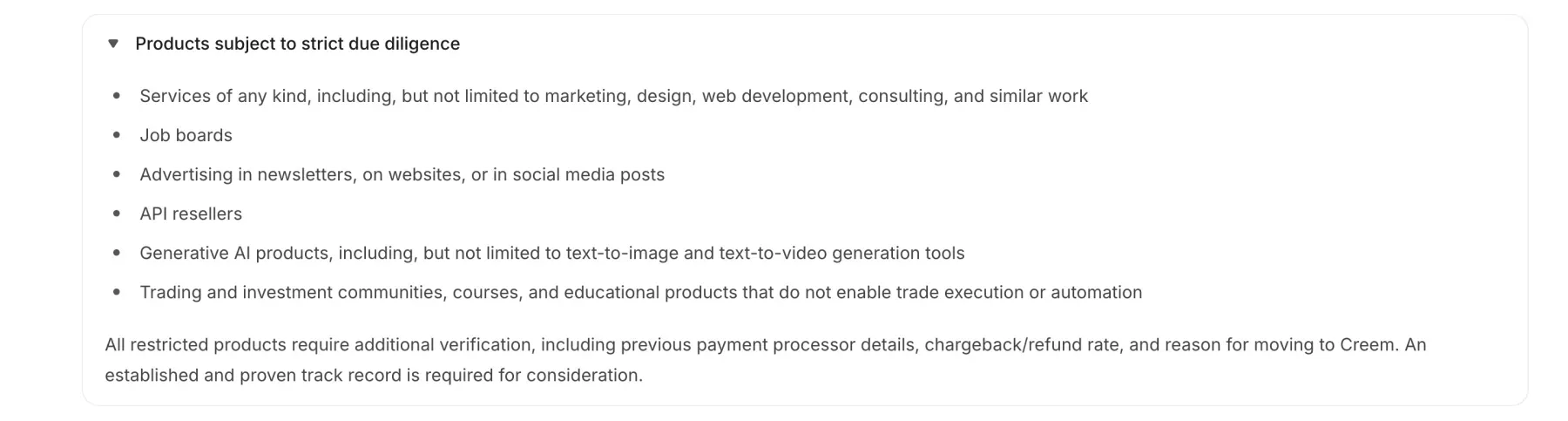
Creem wants your previous payment processor, your chargeback and refund rate, your reason for moving, and "an established and proven track record". A brand-new app has none of those, so Creem is a fit for an AI app that already sells somewhere else, not for a launch.
Then there's moderation. Creem's Moderation API is required for every AI image or video product. Each user prompt must pass through it before it reaches your model, and an account that skips it "may be suspended without notice".

It costs $0.30 per 1,000 units, where a unit is up to 1,000 characters of prompt, and a repeated prompt is free. Cheap. The AI wrapper rules are the bigger change for most apps: no model names in your product name (Creem's own bad examples are "VEO3Studio" and "GeminiVideo"), a statement that you're an independent wrapper, an acceptable use policy and terms that ban NSFW generation, and no "uncensored" marketing. Face-swap, deepfake and AI companion apps are banned outright.
Dodo Payments: reviewed, with moderation on by default
Dodo's merchant acceptance policy lists "AI Content Generation tools (text, image, video, voice)" first under categories that often require review, on condition of no impersonation, scraping or deepfakes. Dodo may ask for disclaimers, demo access or policy links before approving, and approval isn't guaranteed.
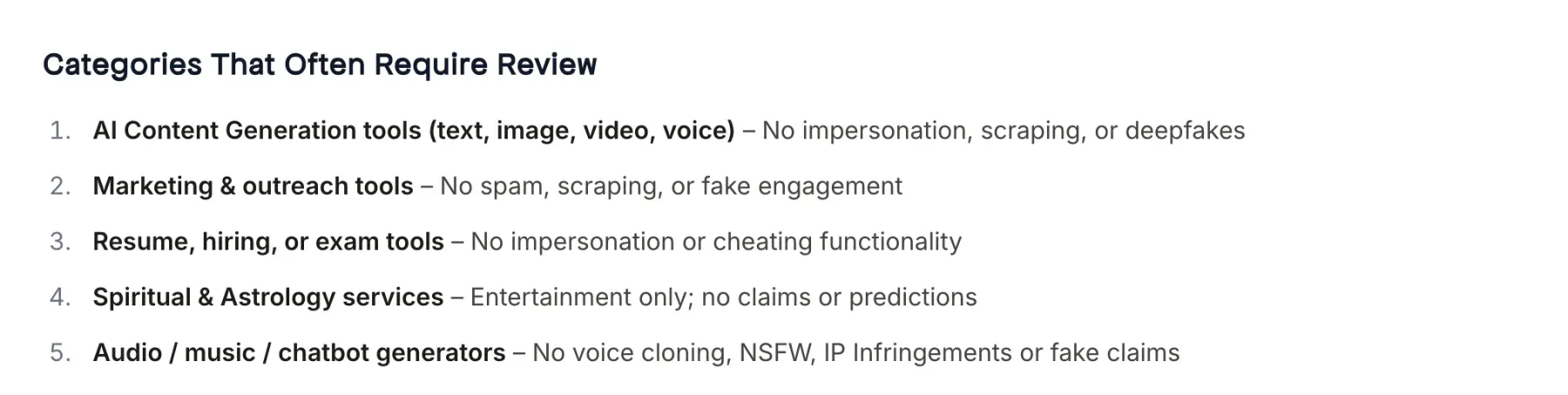
Polar's restricted group uses nearly the same categories in nearly the same words, from AI content generation down to "Audio / music / chatbot generators".
The difference is in what each offers alongside. Dodo's Moderation API is switched on for every business by default and screens a prompt, an image or both, at $0.30 per 1,000 screens with no free tier. Its page doesn't say you must use it, unlike Creem's. Dodo bans AI-generated explicit content, AI relationship companions, face-swap features and reselling AI APIs you have no rights to. If Dodo enforces against you, you get one review, and that decision is final, though Dodo says it may allow corrective action or resubmission in some cases.
What does plain Stripe allow?
Stripe's prohibited and restricted businesses list, last updated September 22, 2026, has one AI line, and it sits under adult content.
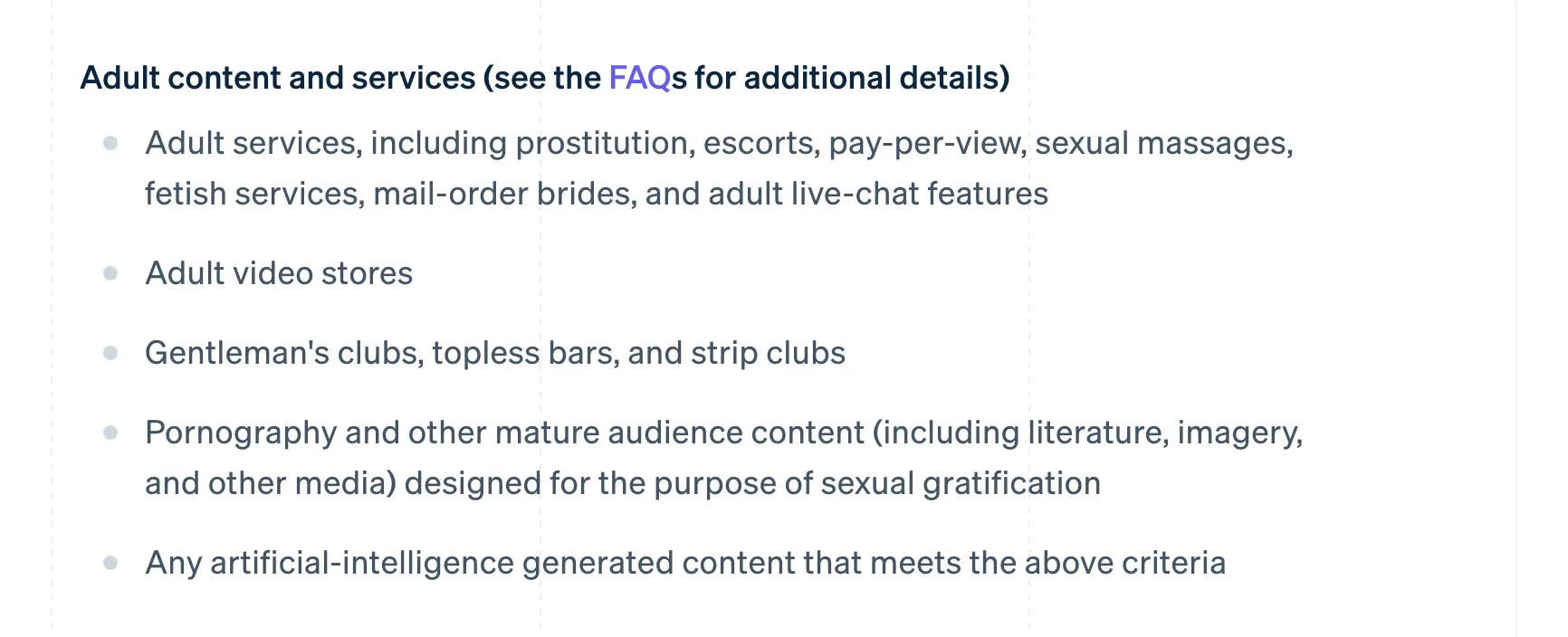
Image and video generators, deepfakes and face swaps aren't named. That makes plain Stripe the provider with the fewest written AI rules here. The catch is that Stripe isn't your merchant of record. You're the seller, so sales tax and VAT in every country you sell to are your job.
Stripe Managed Payments: image generators are a tax code
Managed Payments is Stripe acting as merchant of record, for 3.5% on top of its normal fees. Every product needs one of Stripe's eligible tax codes, and one of them describes AI tools "such as LLMs, image generators, or chatbots".
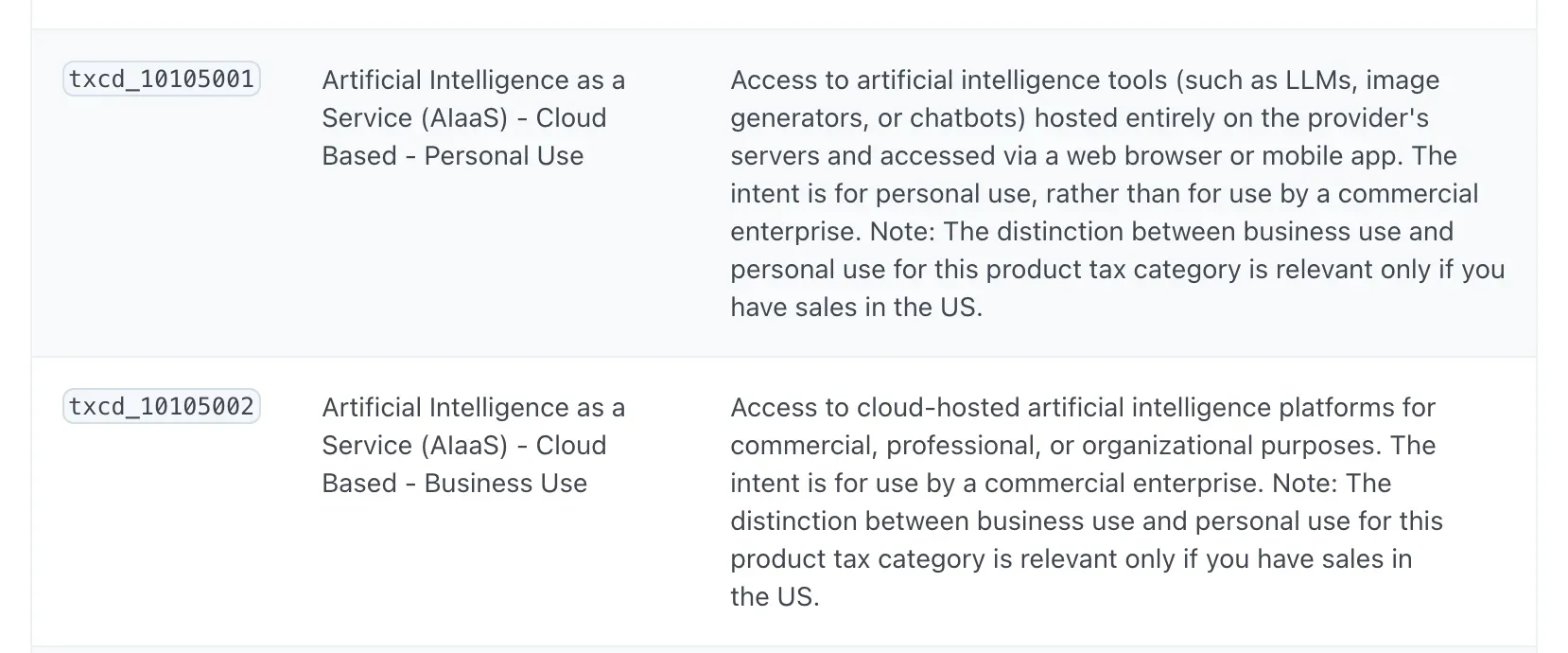
A tax code isn't an approval. Access depends on an eligibility review of your business type and location, and Stripe's restricted list still applies. But it's the only page here that lists image generators among supported products rather than restricted ones.
Which one should a new AI image or video app use?
Launching with no sales history: apply to Dodo or Paddle, or use Stripe directly and handle tax yourself. Dodo reviews the category case by case, and Paddle says it may work with image generation after checks. Creem's track record rule shuts out a launch, and Polar's policy says it may not accept you.
Already selling elsewhere and moving: Creem is now a real option, because you have the processor history and refund rate it asks for. Budget for its moderation API and the branding rules.
Avatars, headshots or anything with human-like faces, realistic or animated: expect Paddle's restricted review at minimum. Keep likeness of real people out of the product.
Face swaps, deepfakes, voice cloning, AI companions or NSFW output: don't plan on any provider here. Paddle, Polar, Creem and Dodo ban some or all of these by name, all six ban AI-generated adult content, Stripe bans products that infringe anyone's privacy rights, and Lemon Squeezy bans whatever its processors restrict.
Whichever you pick, build what Creem demands before you apply anywhere. A prompt moderation step, an acceptable use policy and terms that ban NSFW generation, and a product name that isn't a model's name cover what Creem's pages require and the safeguards and policy links Polar and Dodo say they may ask for. If a provider has turned your AI app down recently, tell us on X at @devtoolpicks. For fees on the providers that took you, our Lemon Squeezy alternatives and Polar vs Lemon Squeezy vs Creem posts go deeper, and Stripe alternatives covers the processors.
Frequently Asked Questions
What happens if a merchant of record rejects my AI app?
It depends on the provider. Creem says a rejection is a final decision for that store, with no button to request another review. Dodo Payments lets you ask for a review of an enforcement decision, but only once, and that answer is final, though Dodo says it may allow corrective action or resubmission in some cases. Changes requested is a different outcome from a rejection. Creem lets you fix the flagged issues and request a re-review. Apply with your Terms of Service, an acceptable use policy and prompt moderation already live.
Get honest tool comparisons in your inbox
Join 50+ indie hackers and solo developers who get new comparisons, pricing changes, and tool picks. No spam. Unsubscribe anytime.
Related Articles

Gemini 4 Argon vs Claude Sonnet 5.5: Cheaper per Call, 3x the Cost per Bug Fix
Same price per token as Claude Sonnet 5.5. Very different bills once you count t...

Best Ollama Cloud Alternatives for Indie Hackers in 2026
Ollama Cloud plans now come with a monthly token credit instead of time-reset li...

LiteLLM vs Portkey vs Cloudflare AI Gateway for Indie Hackers in 2026
Three AI gateways compared at indie scale: self-hosted LiteLLM, Portkey with obs...